Why, For Whom, and When: People Analytics Leaders Use

Why, For Whom, and When: Building People Analytics Leaders Actually Use
It's the time of year when engagement surveys close, performance reviews wrap up and HR teams sit on more people data than at any other point in the year.
At the same time, organizations are racing to layer AI on top of their data. A Gartner survey of 110 HR leaders found that 95% of organizations implemented AI in some capacity over the past year, but only one in five has realized significant or transformational value.
So the problem isn't access to data. It's what happens next. People analytics has gone from spreadsheets to dashboards to AI, yet the hardest question hasn't changed: will a leader actually do something different because of this? At Achieve, we think the answer depends less on the tools and more on three questions every people data request should answer first: why, for whom and when.
The dashboard trap: more data, fewer decisions
In a recent Achieve webcast, Yael Oelbaum, Head of People Data Insights at JetBlue, described a common misconception in the field: that the product is the goal. Get the data out, the thinking goes, and leaders will make the right decisions. Her verdict was blunt.
"I've literally never seen that happen." Yael Oelbaum, Head of People Data Insights, JetBlue
Handing leaders every metric, however well designed, often pushes the work of interpretation onto the people least equipped to do it. Yael's alternative is what she calls "sophistication to scaling back": figure out what a leader needs, and when, to make a specific decision, then deliver a curated insight.
The research backs up the value of that discipline. In Insight222's People Analytics Trends 2025/26 study, 52% of organizations reported measurable business improvements from people analytics. Among the top-performing teams, those most closely aligned to core business priorities, that figure rose to 90%. Alignment, not volume, is what separates them.
Yael's own team learned this the practical way. After building a self-service dashboard for HR business partners, they realized it was designed for analysts, not its users. They stripped it back to foundational metrics like headcount, workforce composition, attrition and performance. HRBP data requests dropped from hundreds a year to around 40.
Ask why, for whom and when before you build
Laura Fisher, Leadership and Organizational Development Leader at JetBlue, says she and Yael add friction to their process on purpose. When a leader says "our managers need training," Laura's first question is whether it's actually a training issue. More often than not, she says, it isn't. Treat the symptom and people feel good for a while, then the same problem comes back.
Yael's team runs every data or analysis request through three questions:
- What business problem are you trying to solve?
- Who is the audience for this information?
- What decision will they ultimately make from it?
Skipping those questions doesn't save time. It moves the cost downstream. Yael shared an example of a leader who wanted to know whether changing how he posted job requisitions had solved a new hire attrition problem. The first pull of the data showed overall attrition, a metric that couldn't answer his question. The right analysis compared new hire attrition for the changed postings against the unchanged ones, over time. Because the HR business partner checked in before reporting back, the team caught it.
This is also why strong employee listening programs start with the decision, not the survey. The question you ask determines whether the answer is usable.
AI in HR raises the stakes on data governance
AI makes analysis faster. It doesn't make data cleaner. Gartner predicted that through 2026, organizations would abandon 60% of AI projects unsupported by AI-ready data. For HR, Yael put the risk in plain terms: drop AI onto weak foundations and you end up "enabling confident wrongness at scale."
Her team's fix wasn't glamorous. They sat down with finance, agreed on how attrition is defined and why, locked down the data workbook and built it into their data infrastructure. A single monthly attrition report now goes to senior leaders and finance as the trusted source, so no one has to calculate it themselves. It's the kind of groundwork we explored in AI in HR: Hype vs. Reality and Why Your Data Comes First, and it's what makes AI for HR leaders an advantage rather than a liability.
Laura offered a useful gut check for anyone consuming AI output or analytics outside their expertise. Ask an AI tool about a subject you don't know and the answer looks amazing. Ask about your own field and you see the holes right away. Data works the same way, which is why she says people analytics should never sit in a bubble.
Prove it works here
Even when external evidence is strong, leaders want proof that a practice works in their own organization. Selection is a good example. A landmark 2022 meta-analysis by Sackett, Zhang, Berry and Lievens in the Journal of Applied Psychology revisited decades of hiring research and found that structured interviews may be the strongest predictor of job performance, ahead of cognitive ability.
JetBlue's people data and organizational effectiveness teams co-led a program, launched in 2021, to bring structured interviews into hiring across the organization. It took supporting technology, practice-based training and a certification gate: no training, no interviewing. When the team finally had enough data to check, the results were clear. By JetBlue's own figures, about 50% of managers who scored well in the interview went on to exceed their performance goals, compared with 30% of those who didn't. The pattern held for other roles, and interview scores also predicted early attrition. That internal proof is now making the case to expand.
Retention strategies that fix the system, not just the person
Much of HR's week goes to one-off fire drills: a high performer at risk, a sudden resignation. Laura's advice is to ask what level the problem sits at before reacting. One person at risk calls for an individual conversation. A pattern of people leaving is a system issue, and treating it one person at a time guarantees it returns.
"We put a Band-Aid on it. It's a wound that needs stitches." Laura Fisher, JetBlue
With Gallup reporting manager engagement at 22%, many of those patterns run through managers, which makes system-level thinking one of the most important employee retention strategies available. People teams are often the only ones who can see across departments and connect the dots.
That cross-organizational view is also why peer exchange matters. The practitioners who do this work well rarely figure it out alone, which is the idea behind the Achieve Leadership Network: an HR community where people leaders compare what's working, pressure-test ideas and build alongside each other.
What this looked like in the room
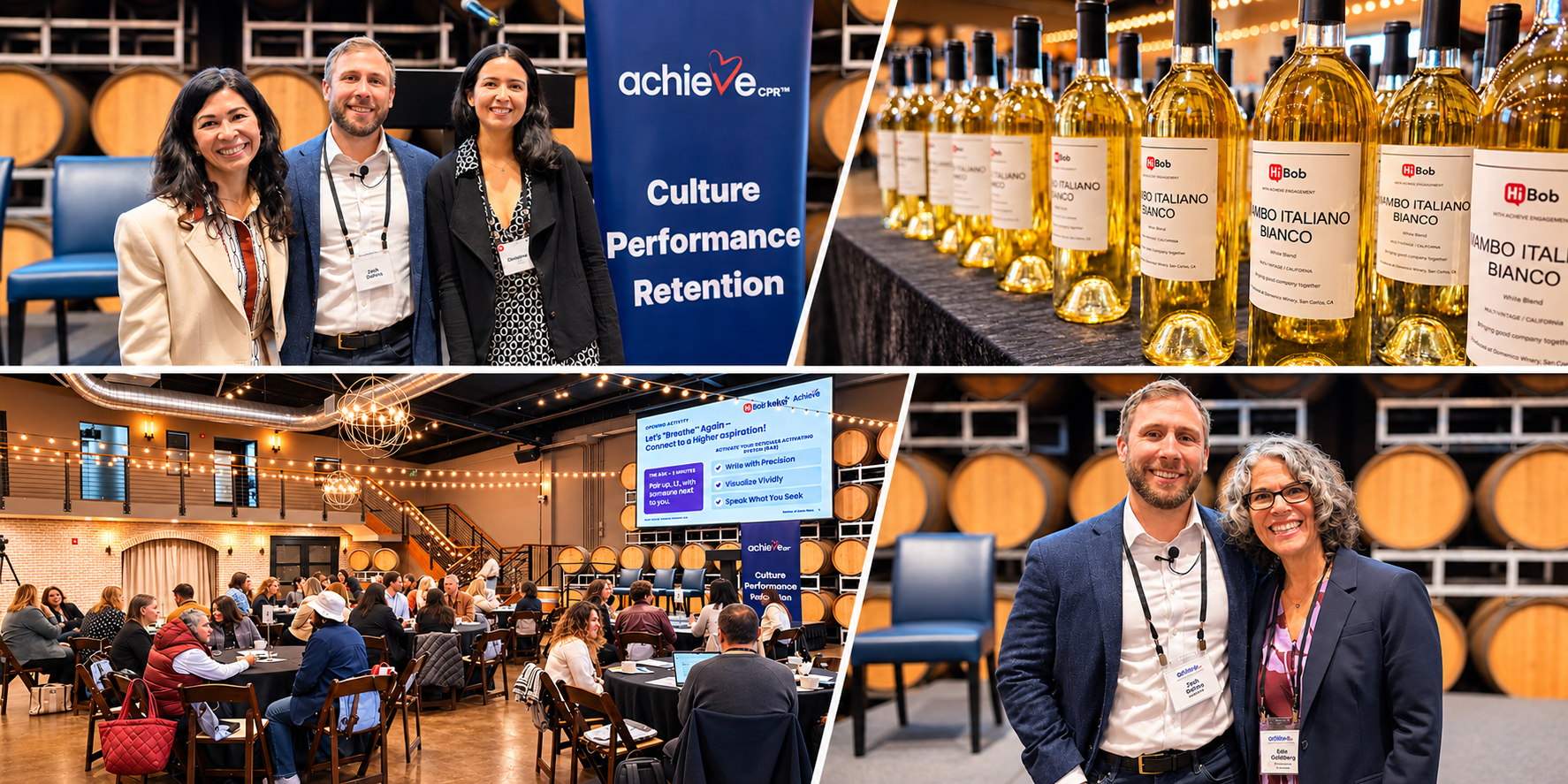
These ideas came from "Why, For Whom, and When: Building People Data Leaders Actually Use," a recent Achieve webcast hosted by Zech Dahms, President of Achieve, with Laura Fisher and Yael Oelbaum of JetBlue. Speaking as practitioners, they covered how people data and organizational effectiveness partner day to day, how to push back on the wrong question, what it takes to build trusted data foundations before adding AI, and how to move from firefighting to a healthier system.
The conversation was shaped by the room. Attendees rated their own people analytics maturity live, raised the tension between automation and self-service, and asked how to move from historical reporting to leading indicators. The group ran out of time with several topics still on the list, which says a lot about how much practitioners want to talk about this.
What this means for HR leaders
The takeaway isn't to build fewer dashboards. It's to build with intent. Start every request with the business problem, the audience and the decision. Lock down definitions before you scale with AI. Prove your practices work with your own data. And when a problem keeps coming back, look at the system. Through the lens of achieveCPR, that discipline strengthens culture, performance and retention at the same time.
Build better people data practices with peers
The best answers to these questions come from people leaders who are working through them right now. The Achieve Leadership Network brings HR and people leaders together for masterclasses, masterminds and peer conversations focused on what's next for the world of work. If you're working to turn people data into decisions your leaders act on, we'd love to have you in the room.