.png)
AI for HR Leaders: Plan Capabilities, Not Headcount
AI for HR Leaders: Why Capability Planning Is Replacing Headcount Planning
Most HR leaders have now restructured their teams more times than they have finished a workforce plan. Priorities move mid quarter. Layers come out, then go back in. And the annual planning exercise meant to account for all of it keeps getting overtaken before it ships.
New research suggests the problem is not effort. It is the question. Only 29 percent of CHROs say they are confident in their organization's ability to deliver on strategic workforce planning goals, according to Gartner survey data cited by Deloitte. McKinsey's newly released HR Monitor 2026 found something similar: just 11 percent of organizations take a genuinely long-term, strategic view of workforce planning, while the rest remain focused on short-term headcount.
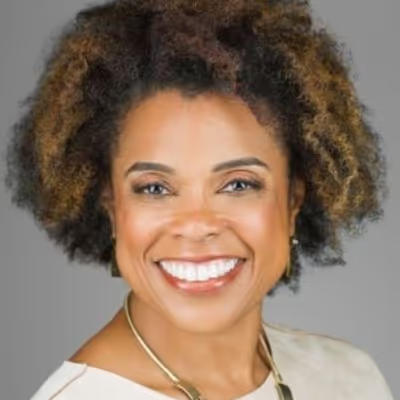
"How many people do we need?" was answerable when org charts held still. It is not the right question anymore. In a recent Achieve Leadership Network masterclass, Twanya Hood Hill, Chief Human Resource Officer, made the case for a different one: what capabilities will this business need to succeed next?
The Planning Question Is Broken
The traditional workforce planning cycle assumes a relatively stable structure: define the roles, forecast the headcount, budget for it, revisit next year. That assumption has not held up well against AI adoption, economic uncertainty, and reorganizations that outpace the planning calendar meant to track them.
The scale of the skills problem underneath that instability is significant. The World Economic Forum's Future of Jobs Report 2025 found that skills gaps are now considered the single biggest barrier to business transformation, cited by 63 percent of employers surveyed. The same report estimates that 59 out of every 100 workers globally will need reskilling or upskilling by 2030, and roughly 11 of them are unlikely to receive it.
McKinsey's HR Monitor 2026 frames the fix directly: organizations need to move workforce planning "beyond operational capacity planning to strategic capability planning," matching skills demand to where automation and AI are genuinely reshaping how work gets done, rather than defending existing headcount plans built for a different kind of year.
From Job Titles to Capabilities: What Actually Changes
Hood Hill's framework starts with a simple reversal. Instead of asking how many people a team needs, ask what work that team is actually responsible for now, and what capabilities, technical and behavioral, that work requires. Job titles and org charts come after that analysis, not before it.
This is not a cosmetic difference. A capability-first approach forces a harder conversation with functional leaders: not "who do we hire," but "what must people be able to do here, and where are the gaps between that and what we currently have." It also means writing roles for the work the business needs, not around the specific person currently doing it, since both the person and the business can change.
The shift tracks with where independent research is pointing. Skills-based organization design, which structures work around what people can actually do rather than fixed job titles, has been gaining traction for several years. Mercer's 2025/2026 Skills Snapshot Survey found that 55 percent of organizations now map skills directly to jobs, up from 47 percent in 2023, a meaningful jump but still short of a majority practice.
AI's Real Job Is Freeing Capacity, Not Cutting It
The clearest illustration of what capability-first planning looks like in practice came from IKEA's Ingka Group, cited during the masterclass. When Ingka deployed its AI assistant, Billie, across customer service in 2021, the bot eventually resolved roughly 47 percent of inbound inquiries, about 3.2 million conversations, saving the company close to 13 million euros in operating costs, according to Ingka Group's own newsroom.
Rather than reducing the call center team by a proportional amount, Ingka looked at the 53 percent of conversations Billie could not resolve. Customers were reaching out for help with room layouts, furniture combinations, and design decisions that required human judgment. Ingka reskilled roughly 8,500 call center employees into remote interior design consultants. That new service line generated 1.3 billion euros in revenue in its first full fiscal year, about 3.3 percent of Ingka's total sales, with a stated goal of reaching 10 percent of revenue by 2028.
The lesson generalizes beyond retail: automation reveals a demand signal, and the workforce plan built around capabilities is the one positioned to act on it. It is also worth noting that Ingka and its franchisor, Inter IKEA, announced separate rounds of layoffs in 2026, driven by declining sales, tariffs, and a shift toward smaller store formats rather than AI displacement. The reskilling program's success does not make a company immune to broader economic pressure. It does show what a deliberate, capability-first response to automation can look like when the business case is there.
The Human Capabilities That Get More Valuable, Not Less
A recurring theme in the masterclass, and in current workforce research, is that AI adoption raises the value of specific human capabilities rather than eliminating the need for them. Hood Hill pointed to relationships, critical thinking, judgment, innovation, and coaching as capabilities that become more important, not less, as AI absorbs more routine and analytical work. Her reasoning: AI can help with lower-level thinking, but it cannot build the trust that gets a leader into a room, and it cannot do the anticipatory, strategic thinking that determines where a business needs to go next.
That framing lines up with where employers are placing their bets. The World Economic Forum's 2025 report identifies analytical thinking, resilience, flexibility and agility, and leadership as being among the fastest-growing skill categories through 2030, alongside technical AI literacy. The two trends are not in tension. Employers are investing in AI skills and in the human capabilities AI cannot replicate, at the same time.
What This Looked Like in the Room
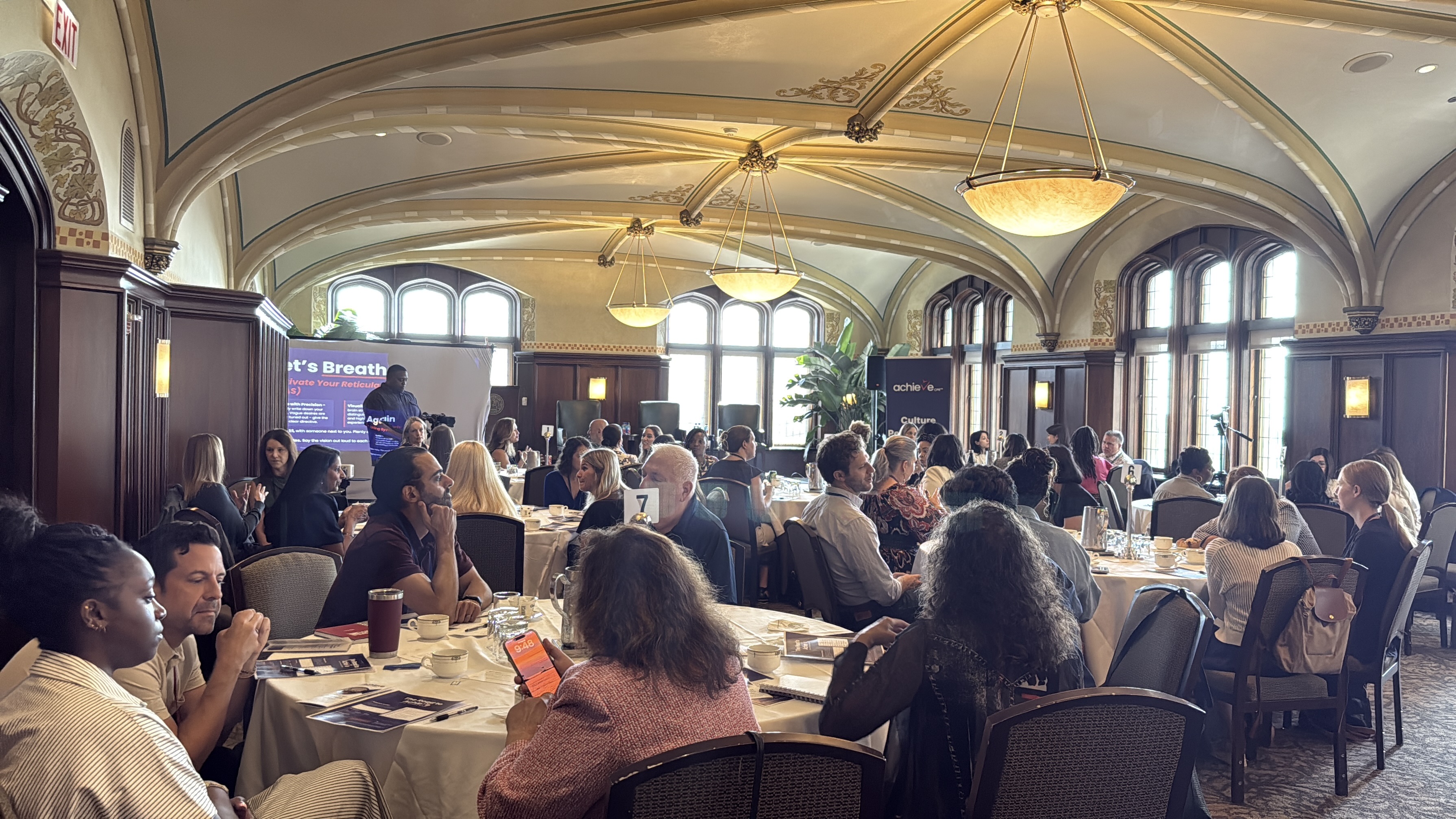
The masterclass, part of Achieve's Becoming a CHRO series, moved well beyond a one-way lecture. Attendees brought their own examples of roles being redefined in real time, from an IT security lead who evolved into what one attendee called an AI responsibility overseer during an organization-wide AI rollout, to shifts inside nursing and healthcare delivery roles.
One of the more practical exchanges centered on where a capped HR budget should go: leadership development, hiring, AI enablement, reskilling, internal mobility, or culture. Hood Hill's answer pushed back on the framing of the question itself. These are not competing priorities to choose between, she argued, they are interconnected capabilities that reinforce each other. The right move is to prioritize based on the moment, not to fund one permanently at the expense of the others.
Attendees also worked through what it takes to earn a seat in AI planning conversations that HR has historically been left out of, and traded language for describing how automating routine, downstream work frees up time for the upstream, relationship-facing work that experienced people are best positioned to do.
What This Means for HR Leaders
The research and the room told a consistent story: the organizations struggling most with workforce planning are the ones still asking a headcount question in a capability problem. Gartner's 29 percent confidence figure and McKinsey's 11 percent adoption figure for strategic planning both point to the same gap, a gap that shows up as reactive restructuring rather than a plan built to absorb the next change.
Closing that gap does not require a perfect long-range headcount model. It requires a habit: asking what capabilities the business needs next, before the next reorg forces the question, and building HR's seat at the table around that answer rather than around a plan that expires the moment the org chart moves again.
That is the kind of conversation the Achieve Leadership Network builds its Becoming a CHRO series around: practical frameworks from HR leaders who have lived through the reorg, the acquisition, and the AI rollout, not just theorized about them. Learn more about joining the Achieve Leadership Network to get access to sessions like this one, along with the broader community of people leaders working through the same questions.