Achieve CPR LIVE in San Francisco: Building a High Performance Culture: Enable, Don't Manage
achieveCPR LIVE in San Francisco: Stop Managing Performance. Start Enabling It.
For the second year in a row, "Leader & Manager Development" is the top priority for CHROs, according to Gartner's 2026 Leadership Perspective Survey of 430 CHROs. There's good reason. In a separate Gartner survey released in April, 47% of managers said more is expected of them and they must work harder than a year ago. For anyone trying to build a high performance culture, that is a warning sign worth taking seriously.
Meanwhile, the process most organizations rely on to drive performance has lost the confidence of the people who use it. In Deloitte's 2025 Global Human Capital Trends research, 61% of managers and 72% of workers could not say they trust their organization's performance management process.
That's the tension HR leaders are living with: pressure to perform is rising while the system built to deliver performance is losing credibility. At a recent achieveCPR LIVE executive session in San Francisco, industrial-organizational psychologist Edie Goldberg argued that building a high performance culture starts with a better question. Not "how do we rate people more accurately?" but "what is performance management actually for?"
Why Traditional Performance Management Stalls Organizational Performance
Goldberg, coauthor with Alan Colquitt of Performance Enablement (Oxford University Press), surveyed 113 CHROs and heads of talent and performance management in late 2020. Asked what their process was for as implemented, most said its purpose was fuzzy or that it existed to evaluate employees and pay for performance. Asked what it should be for, most said driving performance and developing people. Her research found the part of the process built to differentiate employees for pay is the part most responsible for disengaging them.
The ratings that feed those decisions are noisy, too. Two out of three practitioners in Goldberg's study said factors other than performance shape ratings, from forced distributions and pay-band position to retention risk and how much a manager likes someone. Deloitte sees the same problem from the organization's side: 75% of organizations rated their ability to accurately evaluate the value created by individual workers as not very or not at all effective.
Goldberg's diagnosis is structural. Performance management was designed for an industrial era of stable jobs and predictable work. Today's work is complex, collaborative and constantly shifting, and the old assumptions about what motivates people no longer hold.
From Coercive Control to Enabling Control
Goldberg frames performance management as a management control system, alongside strategy and structure, that organizations use to influence behavior. The dominant model is coercive control: set goals as a measuring stick, rate people at year end, tie the rating to pay. Underneath it sits an assumption that people work best when they're monitored, measured, and rewarded or punished.
Enabling control rests on a different set of beliefs: clear direction, transparency, trust, autonomy, positivity and intrinsic motivation. This isn't an argument against pay. Goldberg was explicit that getting pay right matters, and Gartner's recent pay-for-performance research backs that up, finding employees are up to 17% more productive when they believe pay and performance are strongly linked. Her point is that pay is the foundation of performance, not the engine.
"Compensation stole my performance management bus, and I want it back."
Edie Goldberg
Progress Is the Engine of a High Performance Culture
Goldberg opened her keynote by asking the room to picture their best day at work. Chances are it had nothing to do with a rating or a bonus. It was about progress: a problem solved, a milestone hit, a breakthrough. Progress is usually treated as the output of performance, but it also causes it. When people experience progress, they grow more optimistic, bring more energy and persist through difficulty. Decades of research point to the deeper needs underneath: purpose, autonomy, belonging and mastery.
Her performance enablement model translates that science into practice in five layers, designed as an upward spiral that builds momentum like a flywheel:
- Context: what matters and why, which is where purpose comes from.
- Challenging goals for individuals and teams.
- Coaching, feedback and feedforward that use past experience to shape better outcomes, rather than critiquing the past.
- Support: removing barriers, connecting people and providing tools.
- Development of skills, careers and experiences.
Manager Effectiveness Is Where Enablement Lives or Dies
Every layer of that model runs through managers, and managers are stretched thin. Gallup's span of control research shows the average number of people reporting to a manager rose from 10.9 in 2024 to 12.1 in 2025, a nearly 50% increase since Gallup first measured it in 2013. That same Gartner survey found only 39% of employees say their manager is effective at giving clear developmental feedback. Deloitte found just 26% of organizations say their managers are very or extremely effective at enabling the performance of their teams.
Goldberg's answer isn't more process. It's a different job description for managers.
Use goals to motivate, not just measure
Too often, goals go into a drawer in January and come out in December. Goal-setting theory says feedback on progress is what sustains motivation. Goldberg urged regular conversations built on simple questions: What development do you need? What's in your way? How can I help?
Keep goals directional
Business priorities shift mid-year. Goldberg argued goals should be flexible rather than set in stone, with managers setting priorities instead of piling on. Because goals are tied to compensation, organizations hesitate to change them, and that's what keeps people working on yesterday's priorities.
Make one-on-ones the backbone
Goldberg pointed to work by former IBM CHRO Diane Gherson and London Business School professor Lynda Gratton, whose Harvard Business Review article "Managers Can't Do It All" argues the manager role must be reinvented. Goldberg went further: it may be time to separate those who lead the work from those who lead the people. Gallup's team-size research lands in a similar place, concluding that manager talent trumps span of control.
This is exactly the kind of problem members of the Achieve Leadership Network work through together, comparing how their organizations are redesigning the manager role rather than solving it alone.
Where AI in HR Fits
Goldberg sees real promise in AI for HR leaders, as long as it serves the right process. AI can help a manager with a large team understand the context each person is working in, flag who might be stuck, and nudge a conversation when a goal needs updating. Gartner reports that managers using AI saved an average of four hours across parts of the performance management process. Managers are already leading the way: a July 2025 Gartner survey of 2,986 employees found 46% of managers are experimenting with AI to improve their work, compared with 26% of employees. And Microsoft's 2025 Work Trend Index predicts a new role for everyone, the "agent boss," who builds and manages AI agents.
Goldberg's caution: design the process your business needs first, then find technology that enables it. Too many organizations do it the other way around and end up implementing whatever their platform dictates.
What This Looked Like in the Room
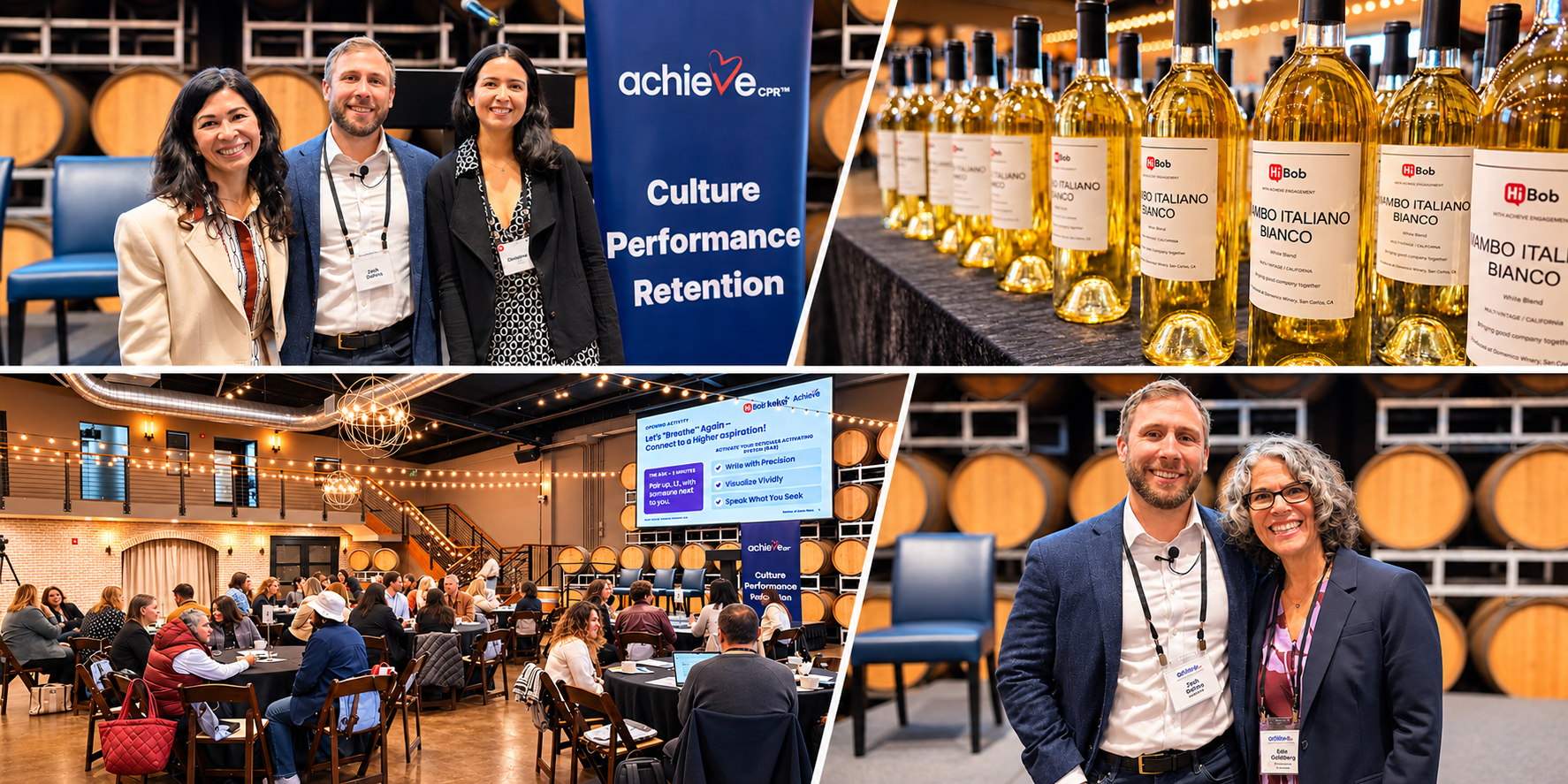
achieveCPR LIVE San Francisco brought senior HR and People leaders together for a half-day executive experience built around Achieve's Culture, Performance and Retention framework. Goldberg's keynote opened the Culture and Performance segment, followed by a fireside chat with Zech Dahms, President of Achieve, and peer exchanges where leaders worked on their own people strategies.
The conversation got candid quickly. When Zech asked how many leaders felt stuck in the old model, rating themselves seven or higher on a ten-point scale, plenty of hands went up. He brought in a question from a recent Achieve Leadership Exchange dinner in New York on how to shift goals with the business without exhausting people. Goldberg walked through an Edward Jones case study on moving to team-based goals, and attendees pressed on manager overload, flattened structures and clunky HR systems.
What This Means for HR Leaders
Goldberg closed with psychologist Chris Argyris's distinction between single-loop and double-loop learning. For decades, performance management has run on single-loop fixes: change the rating scale, add more conversations. "We have tweaked ourselves to death here," she said. Double-loop learning means questioning the assumptions underneath.
For HR leaders, that means asking three things. Is our process designed to judge performance or to drive it? Do our managers have the time, skills and structure to enable their people? And are our systems built around how work actually gets done now? A high performance culture isn't the product of a better form. It's the product of managers who connect people to purpose, keep them focused on what matters and help them see progress. As Goldberg put it, people do not need to be controlled into performing. They need to be enabled to succeed.
Build It Alongside Your Peers
The hardest part of shifting from performance management to performance enablement is changing a belief system, and that's easier with peers who are doing the same work. The Achieve Leadership Network brings HR and People leaders together through masterclasses, masterminds and member-only events to solve problems like this one with collective intelligence, not theory.
Learn more about the Achieve Leadership Network and join the community