.png)
achieveCPR™ LIVE Chicago: Manager Effectiveness: The Real Lever for Performance
Manager Effectiveness Drives 70% of Team Engagement, So Why Are 60% of Managers Never Trained?
Gallup's research is blunt about where performance actually comes from: managers account for at least 70% of the variance in team engagement scores across business units (Gallup). Not compensation, not perks, not the mission statement on the wall. The person running the team explains most of the difference between a high-performing group and a struggling one.
And yet, roughly 60% of new managers report they never received any training when they stepped into their first leadership role (Wharton, citing the Center for Creative Leadership and Gartner). Gartner's own research goes further: 60% of new managers fail within their first 24 months, largely because they were never taught how to lead. Organizations are betting the majority of their performance outcomes on a role they routinely staff and then leave to figure out alone.
That gap, between how much managers matter and how little most organizations invest in making them good at the job, was the throughline of the second panel at achieveCPR™ LIVE in Chicago. Preet Hansra Michelson, Chief People Officer at tms, and Abigail Morrison, HR Manager at Zendrop, walked the room through how they build performance as a system rather than an annual event, and where managers fit at the center of it. Below, we pair their approach with current research on manager effectiveness, recognition, and the gap between job descriptions and the work people actually do.
The Manager Effectiveness Math Nobody Budgets For
If managers explain 70% of the variance in engagement, and most organizations still treat manager training as optional, that's not a small oversight. It's a structural mismatch between where performance outcomes are decided and where development dollars actually go. Michelson framed the individual-contributor-to-manager transition as one of the most pivotal and least prepared-for moments in anyone's career, comparing it to becoming a parent: nobody hands you a manual. Her prescription was intentional, in-person teaching on fundamentals many organizations assume managers will just pick up: how to run a productive one-on-one, how to give and receive feedback, and how to read a situation and adjust leadership style accordingly.
The research backs up why that investment matters disproportionately. Gallup's broader manager research has found that engaged managers report lower rates of stress, anger, and sadness than individual contributors, and are meaningfully more likely to be thriving in their overall lives, an effect that ripples down to the teams they lead. An untrained, unsupported manager isn't a neutral variable. Left unaddressed, that 70% figure works against an organization just as easily as it can work for one.
Building Performance as a System, Not a Program
Michelson opened the panel with her two non-negotiables for HR to function as a genuine performance driver: understanding how the business actually makes money, and staying close enough to the CEO's priorities that people strategy translates directly into business strategy. Her closing line captured the stakes of getting this wrong: "High performance isn't an HR program. It's an organizational system." Treated as a program, she argued, managers and leadership alike will treat it as optional. Treated as a system, it touches succession planning, total rewards, and the entire employee lifecycle.
Abigail Morrison offered a name for what happens when that system lags the business: the "rubber band effect," the tension that builds when a company's aspirations stretch faster than its people systems, goals, and compensation structures can follow. At Zendrop, that tension showed up directly in compensation design. The standard promotion and pay-increase cycle was tied to mid-year and end-of-year reviews, workable until rapid growth and a merger made a single annual track too slow. Morrison's team added a second, off-cycle path for promotions and increases tied to business change, letting compensation move at the speed the business actually required.
Michelson described a related fix she calls "sliding left": pushing goal-setting earlier in the calendar after noticing goals often weren't finalized until March, a full quarter into the year employees were about to be evaluated on. Her ask of leadership: have a working sense of budget by year end, let managers take a first pass at goals in January, and finalize them, tied to both job description and business priorities, before the month is out.
Job Descriptions Are a Performance Tool, Not Paperwork
The pace of change both panelists described is not anecdotal. The World Economic Forum's Future of Jobs Report 2025 estimates that employers expect 39% of workers' core skills to change or become outdated by 2030 (World Economic Forum). A job description written today is describing a role that will look different well before its next scheduled review.
Morrison's response was structural: a template that lets managers, not a small HR team, write and own internal job descriptions for every role at Zendrop, tied directly into mid-year and end-of-year reviews so the company can catch role creep at a fast-growing organization and build the case for promotions when a role has genuinely expanded. Both panelists acknowledged a shared gap, though: neither organization has consistently updated job descriptions to reflect AI competencies. As Michelson put it, it is difficult to hold people accountable to expectations that were never communicated to them, "asking people to deliver tomorrow's strategy through yesterday's jobs and systems," in the words of a line Morrison had written down earlier in the day.
Recognition Is a Performance Lever, Not a Nice-to-Have
Both panelists pushed back on the idea that recognition is a soft, secondary concern. Morrison's team names the specific behavior being recognized rather than just the outcome, and does it publicly, on Slack and during all-hands calls, so recognition reinforces the standard for the whole team. Michelson described a period of extreme tariff volatility affecting her company's Southeast Asia manufacturing operations, when her team began publicly rewarding a specific value, scrappiness, through town halls and informal huddles so employees understood in real time what leadership needed from them.
Recent Gallup and Workhuman research on nearly 3,500 employees, tracked from 2022 to 2024, backs up the instinct: employees who receive high-quality recognition are 45% less likely to have left their organization after two years, and those currently receiving recognition that meets at least four of Gallup's five pillars of strategic recognition are 65% less likely to be actively job hunting (Gallup and Workhuman). Employees whose recognition meets four or five of those pillars are roughly nine times as likely to be engaged as those who receive none. Yet the same research found only 22% of employees currently say they get the right amount of recognition for their work, a gap between what's proven to work and what most people actually experience.
Michelson was careful to note that recognition doesn't have to be monetary. She described sending a mid-level leader to a sustainability program at Cornell, an investment with no tie to base pay or incentive compensation that nonetheless built lasting loyalty. Both panelists agreed that recognition preferences vary by person, echoing the idea of individual "appreciation languages" that leaders need to learn rather than assume.
What This Looked Like in the Room
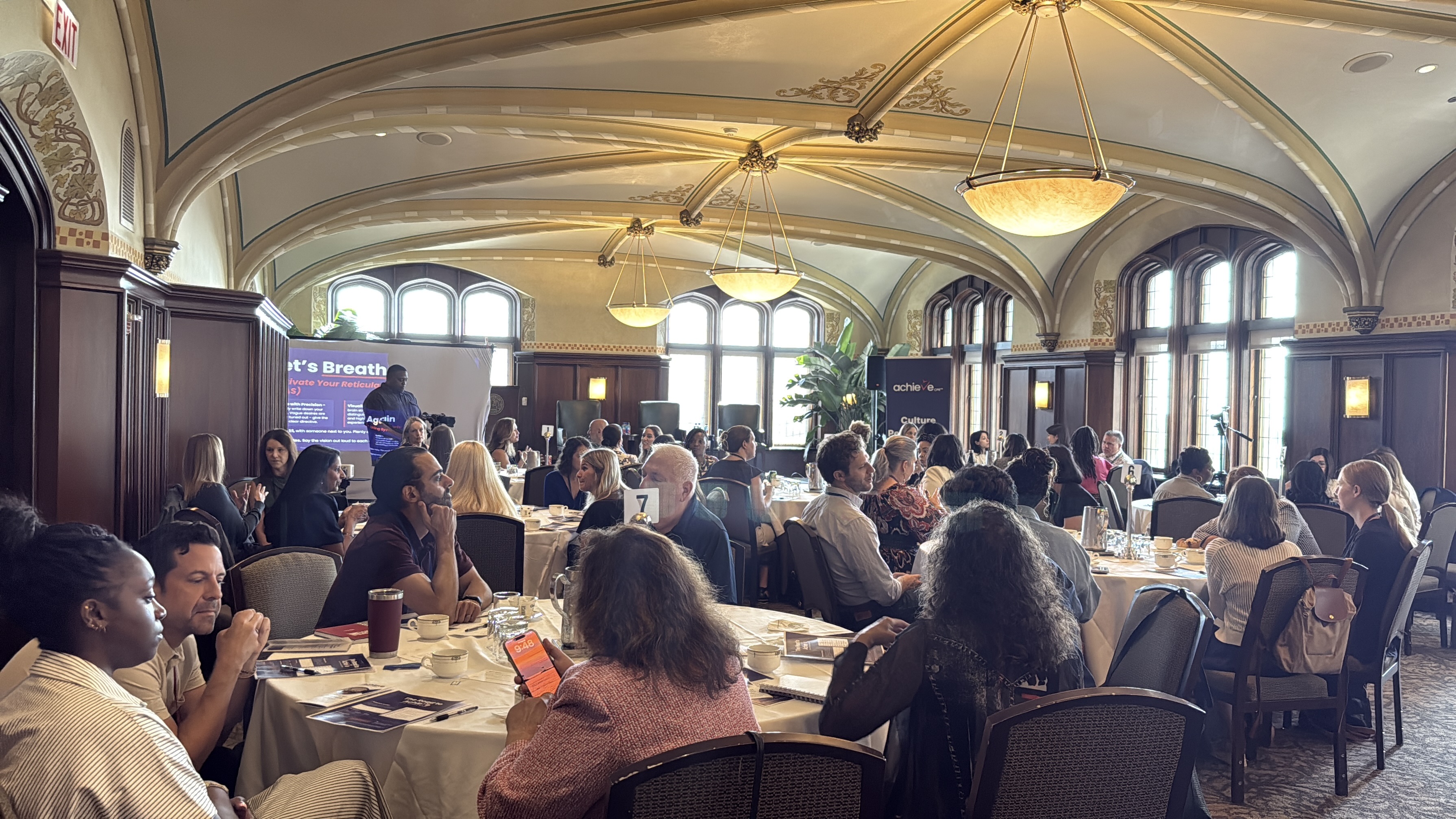
This panel was the second of the day at achieveCPR™ LIVE in Chicago, following the opening culture panel and building toward the event's retention discussion, all organized around the achieveCPR framework: Culture, Performance, and Retention. Host Zech Dahms guided Michelson and Morrison through direct conversation, punctuated by moments where the panelists turned questions back on the room. When Michelson asked how many attendees had updated AI competencies into their job descriptions, the response made clear most organizations in the room had not done so consistently. She later asked, by show of hands, who had worked for a bad manager, and then a great one, using the near-universal response to both to underscore how much a single manager shapes someone's experience of a company.
What distinguished this conversation from a typical panel was the specificity. Rather than abstract advice, both leaders described the actual mechanics they had built: a second compensation track, a job description template with a clear owner, a goal-setting calendar moved up by two months. The session's afternoon shifted into small-group peer discussion, where attendees worked through where performance clarity was breaking down in their own organizations and what plays they were running to fix it.
Sessions like this one are what the Achieve Leadership Network is built around: practitioner-led conversations where HR and people leaders share the specific systems they've built, not just the theory behind them. Members get access to the full recording of this panel, the peer playbook exercises from the afternoon session, and year-round programming built around the achieveCPR framework.
Learn more about joining the Achieve Leadership Network →
The Bottom Line
The research and the panel point to the same conclusion from different directions: performance is not primarily a program HR runs once a year, it is a system that lives or dies at the manager level. Managers explain the majority of engagement variance, most are never trained for the role, job descriptions decay faster than most review cycles can keep up with, and recognition, done well, is one of the most reliably documented levers for retention available to any organization. None of that requires a large budget to start. It requires treating goal-setting, job descriptions, and recognition as infrastructure rather than paperwork, and treating the manager relationship as the highest-leverage investment a people function can make.