.png)
Employee Listening: From Hindsight to Foresight
Employee Listening That Drives Decisions: Moving HR From Hindsight to Foresight
Global employee engagement has now fallen two years in a row. Gallup's State of the Global Workplace 2026 report puts it at 20% in 2025, its lowest level since 2020, and estimates that low engagement cost the world economy roughly $10 trillion in lost productivity. Most of the decline came from managers, whose engagement dropped from 31% in 2022 to 22% in 2025.
Here's the uncomfortable part. Most organizations saw some version of this coming in their own employee listening data. They ran the engagement survey. They collected exit interviews. They built the dashboard. And then the numbers arrived after the damage was done. As most HR teams practice it, listening is a rear-view mirror.
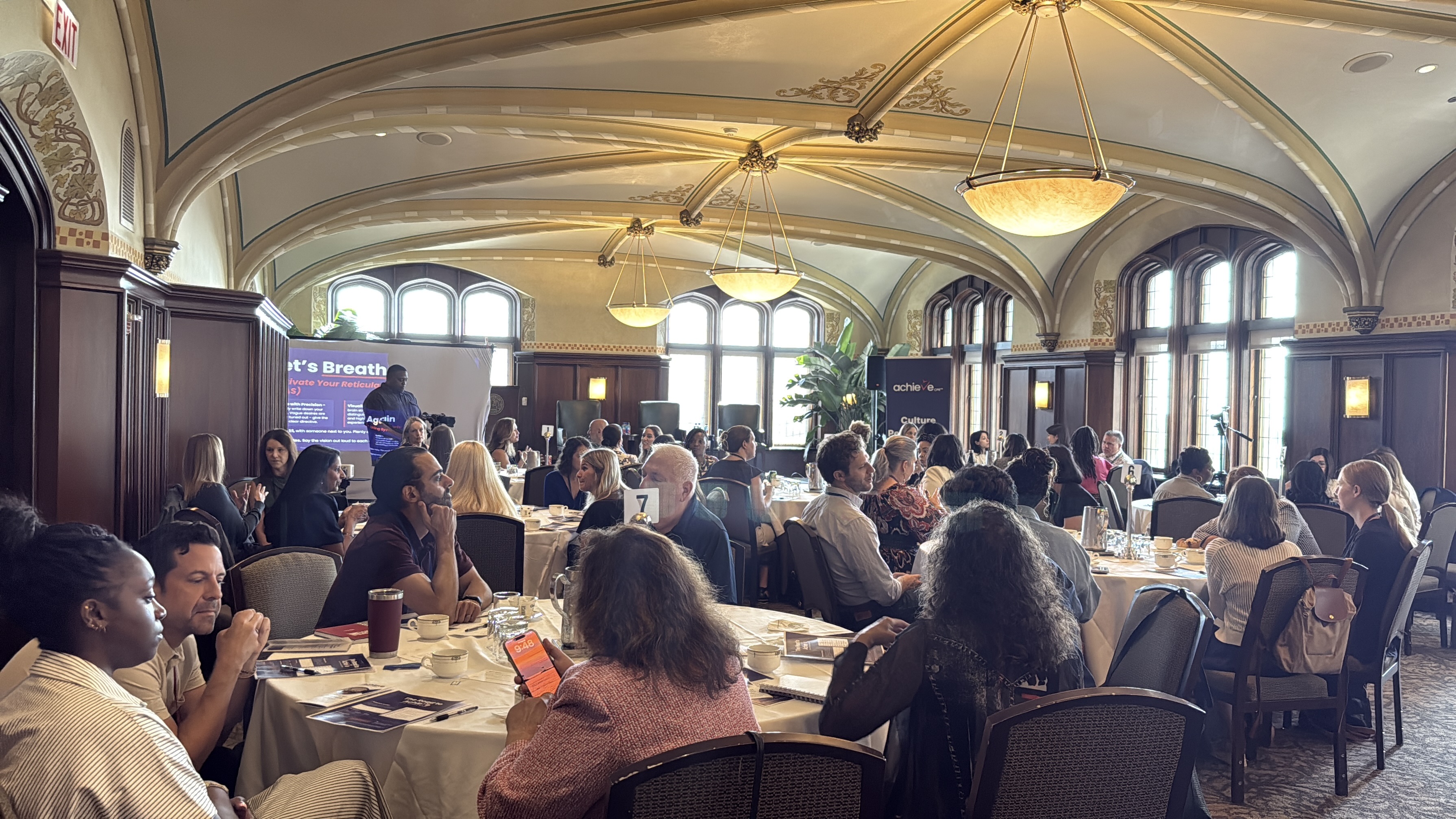
That was the tension at the center of a recent Achieve session, "From Hindsight to Foresight: The Foundations of Workplace Intelligence." The argument was simple: the goal of listening isn't more data. It's better, earlier decisions about culture, performance, and retention.
Why Most Employee Listening Stays Stuck in Hindsight
HR isn't short on data. It's short on data that changes anything. HR.com's State of People Analytics 2025-26 found that fewer than one in four HR teams are highly effective at people analytics, and that only 45% of HR professionals believe their analytics systems improve talent and business decisions, down from 57% two years earlier.
Part of the problem is structural. Most people leaders don't run a dedicated analytics team. They're wearing the analyst hat on top of everything else, often while spending the bulk of the week responding to resignations, escalations, and last-minute requests. It's hard to think three moves ahead when the calendar is full of fires.
The other part is definitional. Teams use "employee listening," "people analytics," and "workplace intelligence" interchangeably, which blurs what each is supposed to deliver. The session drew clean lines between them:
- Employee listening is the active collection of signals. Some are solicited (engagement surveys, exit interviews, 30-day onboarding check-ins). Others are unsolicited, like who registers for a program and who actually shows up.
- People analytics is a function: the people, often a single HR leader in smaller organizations, who analyze those signals and report back on how the organization is operating.
- Workplace intelligence is the outcome: turning patterns in how a workforce behaves into foresight about risks like turnover and disengagement, delivered in a form leaders can actually use.
That last point matters. As one speaker put it, intelligence has to be consumable, not just for HR, but for the managers and executives who need to act on it.
A Five-Stage Maturity Model for Workplace Intelligence
To help leaders locate themselves, the session introduced a simplified Workplace Intelligence Maturity Model. Each stage builds on the last:
1. Reactive: hindsight by accident
Something happens (a key leader resigns, a team flares up) and HR responds. Every organization lives here some of the time. The real question is what share of time. If it's most of the week, that's a signal the listening and analytics infrastructure isn't there yet.
2. Reporting: dashboards that describe the past
Heat maps, weekly updates, and annual performance reviews live here. They're useful, but they still arrive after the fact, sometimes months after.
3. Insight: connecting data sets to find root causes
This is where teams compare signals across sources to understand why something happened. It's still hindsight, but with reasoning behind it.
4. Foresight: flagging risk before it lands
Patterns start pointing forward. The session's example: an employee who hasn't had a career conversation in six months is a potential flight risk. That's the kind of signal that turns retention strategies from exit-interview postmortems into early conversations.
5. Decision advantage: foresight that changes what leaders do
The final stage isn't more sophisticated analysis. It's action. Foresight only counts when it shifts a decision, a plan, or an investment.
When attendees rated their own maturity on a one-to-five scale, most landed between two and three. That cluster rings true: plenty of teams have moved past pure reaction and are producing reports, but few have a clear route from insight to foresight.
Start With the Decision, Not the Dashboard
The most practical idea from the session runs counter to how many analytics projects begin. Before building a report, identify the decisions leaders are actually trying to make. Gartner has framed the same shift for people analytics teams, urging a move from being data-driven to being decision-centric.
The session added a useful diagnostic. Plot your team on two axes: signal strength (do you have usable data?) and decision proximity (are you empowered to act on it?). Weak on both, and you're flying blind. Strong proximity with weak signals means winging it. Strong signals with no path to action is the reporting trap, where dashboards become decoration.
The reporting trap is common enough that one story from the session landed hard. A leader who was constantly asked for reports finally asked recipients how they used them. The answer, often, was that they didn't. He cut half of them. The lesson for any employee experience strategy: pulse check whether anyone acts on what you send, and stop producing what nobody uses.
"The thing that I'm providing, are people finding value or benefit from it? If not, stop doing it." (Megan Bickle)
Three First Moves for HR Leaders
Run an employee listening audit
Inventory what you already collect: onboarding surveys, exit surveys, pulse checks. Who owns each one? When were the questions last updated? What's the response rate? In one example from the session, a data owner could report that 1,100 people had completed an exit survey but not what share of departing employees that represented. A number without a denominator isn't insight, and gaps like that often reveal the need for a basic data governance plan.
Answer a question the business is already asking
At GE Digital, a talent team offered its sales organization something specific: the two or three skills that separate top performers from average ones. Sales shared compensation data, the team blended it with skills data, and the output shaped hiring criteria and upskilling content. That kind of targeted work matters more as skills shift. The World Economic Forum's Future of Jobs Report 2025 finds employers expect 39% of workers' core skills to change by 2030.
Have the confidence to say there's no story
Not every correlation exists. Asked once to link engagement data with attrition, one practitioner found no meaningful relationship and said so. Resisting the urge to force a narrative is part of what earns HR credibility as an advisor.
Where AI in HR Fits (and Where It Doesn't Yet)
AI is often pitched as the shortcut from reporting to foresight. The evidence says it isn't there on its own. A Gartner survey found that 88% of HR leaders say their organizations haven't realized significant business value from AI tools. Gallup reports a similar gap: among U.S. employees in organizations that have implemented AI, only 12% strongly agree it has transformed how work gets done.
That doesn't make AI irrelevant to workplace intelligence. It means the foundations come first: clean, governed data; clarity about the decisions it should inform; and leaders ready to act. Without those, AI just produces faster hindsight.
What This Looked Like in the Room
The session was hosted by Zech Dahms, President of Achieve, alongside Megan Bickle, a talent strategy leader who has built employee listening and people analytics capabilities at companies including GE Digital, Western Digital, Dropbox, and Amplitude. The conversation moved between definitions, the maturity model, and practitioner stories, with attendees scoring themselves live and sharing where they felt stuck.
Some of the most memorable moments were the simplest. Megan explained descriptive versus predictive analytics through her marathon training data: a 12-week mileage chart tells you what happened, while a race-time prediction tells you what you're capable of. Zech made the case that data only becomes interesting when it's tied to an outcome you care about. And Megan's closing advice was the kind people leaders can act on this quarter: stop looking at performance, engagement, and attrition data in isolation, and start blending the signals.
Members of the Achieve Leadership Network can watch the full session and dig into the complete maturity model, the practitioner examples, and the peer discussion in the member resource library.
Build Foresight Alongside Peers Who Are Doing the Same Work
Moving from hindsight to foresight isn't a software purchase. It's a leadership capability, and it develops faster when HR leaders can compare notes with peers facing the same pressures on culture, performance, and retention.
That's the work of the Achieve Leadership Network: a membership community for HR and people leaders built around masterclasses, masterminds, member-only events, and tools that help leaders turn what they're hearing from their workforce into decisions that stick. If your team is somewhere between reporting and insight, you're in good company, and you don't have to figure out the next stage alone.
Explore the Achieve Leadership Network and join the next session