.png)
achieveCPR™ LIVE Chicago: Employee Retention Strategies for 2026 That Actually Work
Employee Retention Strategies for 2026 That Actually Work
Global employee engagement just hit its lowest point in six years. According to Gallup's State of the Global Workplace 2026 report, only 20 percent of employees worldwide were engaged in 2025, a decline Gallup estimates cost the global economy roughly $10 trillion in lost productivity. At the same time, the first major AI hiring discrimination lawsuit is working its way through federal court, and a new national survey found that most employees no longer believe their employer's stated reasons for calling them back to the office. Retention has always mattered. What's different in 2026 is how much of the old playbook, perks, annual engagement surveys, predictive dashboards, is failing to keep up with what people actually need to hear.
The employee retention strategies that are working right now look less like software and more like a habit of honest conversation. That was the throughline of a recent achieveCPR™ Live panel in Chicago, where Jyl Feliciano, Global VP of People, Culture & Belonging at Highspot, and Jill Washington, Chief People Officer at Peoples Bank, compared notes on what is actually keeping people from walking out the door. Here is what the research backs up, and where retention strategy is headed next.
The Real Cost of Losing Your Best People
Turnover math still surprises people who haven't run the numbers recently. Gallup estimates that replacing a single employee costs one-half to two times their annual salary, and that voluntary turnover collectively costs U.S. businesses roughly $1 trillion every year. What's more striking is how preventable most of that cost is. In the same research, 52 percent of employees who voluntarily leave say their manager or organization could have done something to keep them, and 51 percent say no one talked to them about their job satisfaction in the three months before they left.
That statistic tracks closely with what Washington described from her own organization. Peoples Bank, a $2.1 billion community bank in Munster, Indiana, sees roughly 20 percent annual turnover at the executive level, a number she ties largely to the wave of consolidation reshaping community banking right now. Her response isn't a new platform. It's a habit: ask people directly what would make them stay, and act on the answer before they're already out the door.
Retention Strategies Start with Conversations, Not Dashboards
Feliciano's framing of retention at achieveCPR Live was direct: it isn't a metric to chase on its own, it's what happens when culture and performance are already working together. Chasing 100 percent retention is unrealistic, and some attrition is healthy. The more useful question isn't whether people will show up, but what version of themselves they're willing to bring once they do, an idea Feliciano summarized with the acronym WIIFM: what's in it for me.
That question is exactly what Gallup's engagement data is picking up at scale. The 2026 State of the Global Workplace report found that manager engagement fell from 27 percent to 22 percent between 2024 and 2025 alone, the steepest single-year drop Gallup has recorded, with managers now driving much of the variance in how engaged their teams are. A retention plan built on a real company culture strategy has to start there: a disengaged manager can't run the kind of stay interview that catches a flight risk before it becomes a resignation letter.
The Predictive Analytics Trap: What AI for HR Leaders Can and Can't Tell You
Predictive analytics came up repeatedly on the achieveCPR Live panel, and the two Chief People Officers landed in different places on where the line sits. Feliciano described layering AI onto engagement scores, exit interviews, and years of historical data to flag which teams are at risk before they lose people, calling it a genuine shift from reacting to problems after a survey confirms them, to seeing risk coming. Washington, whose organization doesn't have budget for that kind of tooling, relies on direct stay interviews instead. Both agreed a hybrid of analytics and conversation works better than either alone.
Where they were unanimous was on using AI to predict which job candidates are more likely to stay long-term. Feliciano called that a legal and ethical risk, not a shortcut: predictive models can flag patterns like frequent job changes without the context behind them, penalizing candidates for circumstances, a military move, a caregiving gap, that have nothing to do with future performance. That caution lines up with where the law is actually heading. In Mobley v. Workday, a federal judge allowed a nationwide collective action to proceed under the Age Discrimination in Employment Act, and in June 2026 denied Workday's motion to dismiss related disability and race discrimination claims tied to its AI-powered candidate screening tools, according to SHRM's reporting. The court has signaled that when an AI vendor's tool performs a traditional hiring function such as screening or ranking candidates, the vendor can be treated as acting on the employer's behalf, meaning the legal exposure doesn't stop at the software company. SHRM's coverage of the case recommends four concrete steps for HR leaders: inventory every AI tool touching employment decisions, demand vendor bias-audit documentation, keep a human reviewer with real override authority in the loop, and strengthen indemnification language in vendor contracts.
When Return to Office Becomes a Trust Problem
The panel spent real time on return-to-office policy, not as a logistics question but as a test case in how employer decisions get communicated. Washington's take: employees will generally respect a decision they dislike if it's explained honestly and tied to a real business reason. What erodes trust is a vague justification, wanting people back because it's "better for culture," without saying why.
That instinct is well supported by new research. A 2026 survey of 1,000 full-time U.S. employees who had experienced a new or stricter return-to-office policy found that 72 percent suspect the mandate is really a "stealth layoff," designed to push voluntary attrition without the cost of severance. Even among employees who didn't go that far, average trust in the stated reason for RTO landed at just 59 out of 100. Feliciano described Highspot's alternative: tying in-office days to specific, valuable moments, like leadership visits and key meetings, so the reason for showing up is concrete rather than assumed. Employees will still test that reasoning, she said, but a clear and honest why is what keeps a hard decision from turning into a retention problem of its own.
Retention Strategies for a Workforce That Isn't One-Size-Fits-All
Both panelists pushed back on generational stereotypes as a basis for retention planning. Feliciano's organization found more variation within generations than across them, and recommended a menu approach: build a set of benefit and program options employees can choose from, informed by data on individual needs rather than age brackets, and monitor utilization closely enough to retire what isn't working. Washington illustrated the same principle with a health plan decision at Peoples Bank: rather than assume one option fit everyone, the bank surveyed employees, kept an existing plan that already worked, and added a new option alongside employee education.
That instinct matches what HR leaders are bracing for nationally. In SHRM's 2026 CHRO Priorities and Perspectives research, 47 percent of Chief HR Officers said they expect increased challenges, and opportunities, from managing a multigenerational workforce this year. Retention strategies that treat a five-generation workforce as one audience are increasingly out of step with where both the research and the practitioners are landing.
What This Looked Like in the Room
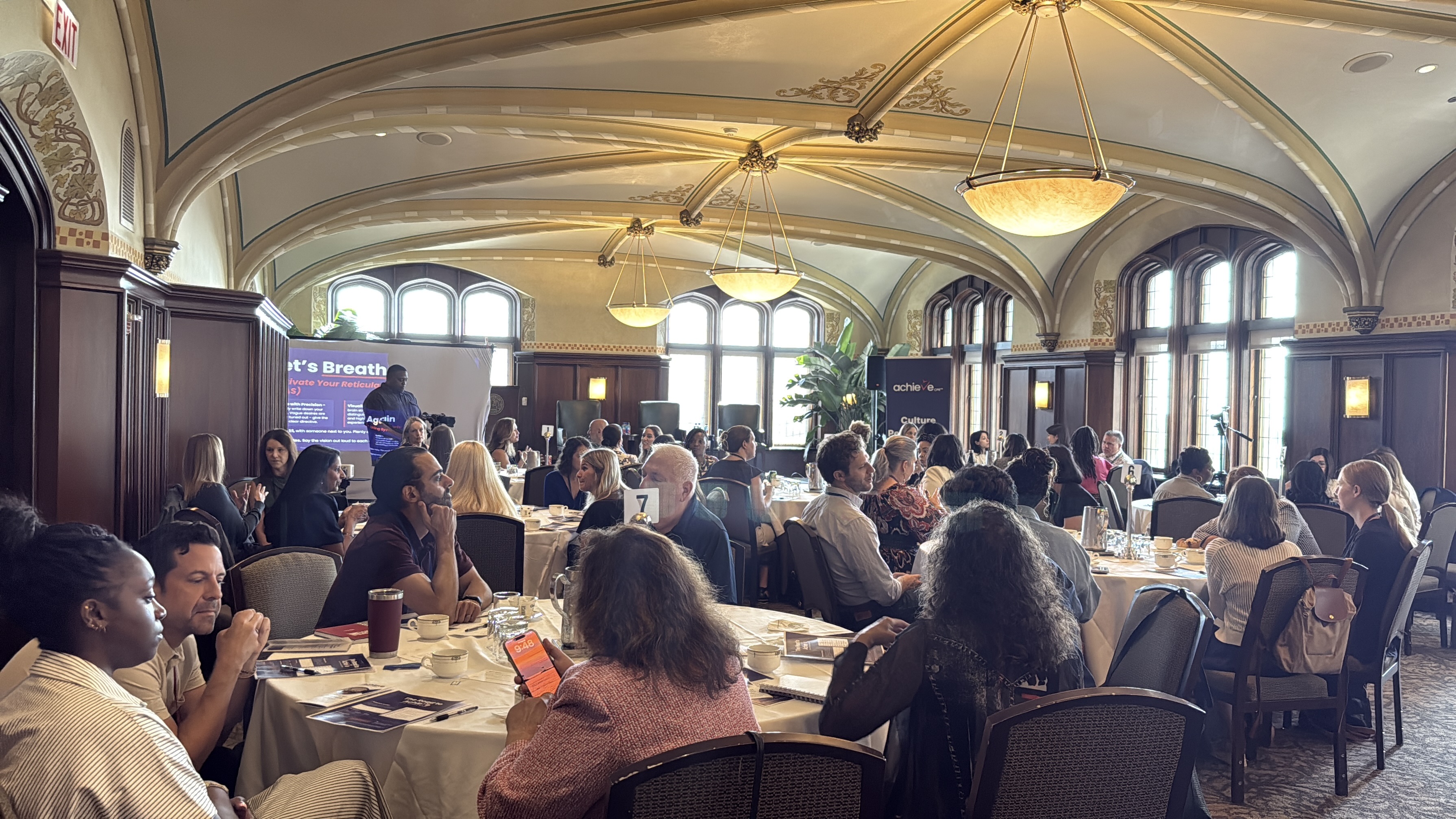
This conversation was part of achieveCPR™ Live, Achieve's practitioner-led event series built around the achieveCPR framework: Culture, Performance, and Retention. The Chicago session paired Feliciano and Washington for a moderated panel that moved from open discussion into audience questions, including a live question about whether predictive analytics could help choose between two job finalists. (Feliciano's answer: hire the most qualified candidate, and let retention practice do the rest.) The room also heard directly from other HR and people leaders in attendance, comparing notes on stay interviews, caregiving benefits, and what tenure realistically looks like now compared to a generation ago.
Where to Go From Here
Retention in 2026 isn't won with a new tool. It's won with the unglamorous discipline of knowing who you need to keep, asking them what would make them stay, and being honest when a hard decision doesn't have a popular answer. If that's the kind of practitioner-level conversation you want more of, sessions like this one are part of what happens inside the Achieve Leadership Network, where HR and people leaders trade real strategies instead of theory. Learn more about joining the Achieve Leadership Network.