.png)
achieveCPR™ LIVE Chicago: Company Culture Strategy: What Actually Works in 2026
Why Global Engagement Just Hit a Five-Year Low, and What a Real Company Culture Strategy Looks Like
Employee engagement worldwide fell to 20% in 2025, its lowest level since 2020 and the first time Gallup has recorded two straight years of decline. The firm puts the cost of that disengagement at roughly $10 trillion in lost productivity globally, about 9% of world GDP (Gallup, 2026). Culture, so often treated as a feeling leadership hopes employees have, is actually a hard business variable, and most organizations are losing ground on it.
McKinsey's newest research backs that up: 75% of organizations say they are failing to build a high-performance culture, even as productivity climbs to the top of the executive agenda (McKinsey, State of Organizations 2026). The gap isn't ambition, it's execution: knowing what to actually do to turn culture from an aspiration into a strategy with the same rigor as a sales plan.
That question, what an intentional, business-tied culture strategy actually looks like in practice, was the subject of the opening panel at achieveCPR™ LIVE in Chicago. Three HR leaders, Terra Martire of Sara Lee Frozen Bakery, Annie Rosencrans of HiBob, and Jennifer Bauer of rf IDEAS, walked the room through the specific tactics they use to move culture from something that happens to them to something they build on purpose. Below, we pair what they shared with the latest third-party research on why culture strategy is breaking down for most companies, and what separates the organizations getting it right.
The Business Case: Culture Is a Strategy, Not a Sentiment
Jennifer Bauer, VP of Human Capital at rf IDEAS, opened with a pointed critique of how HR is often perceived: as though people professionals carry a "magic wand" that can sprinkle culture dust over an organization and fix engagement on contact. The reality, she argued, is that culture requires the same sustained investment and executive buy-in as any strategic priority, backed by a clear ROI: the cost of turnover, churn, and lost recruiting effort when culture is left to chance.
That framing lines up with what McKinsey is seeing at scale. Among the roughly 10,000 senior executives surveyed for the State of Organizations 2026 report, the leading barriers to building a high-performance culture were limited career progression (47%), a lack of targeted incentives (43%), disengaged employees (38%), and rigid performance-management systems (38%) (McKinsey, 2026). None of those are problems a values poster can solve. They are structural issues that require the ROI-driven, leadership-backed strategy Bauer described.
Where Culture Strategy Actually Breaks Down: The Manager Gap
If there is one place culture strategy is quietly failing right now, it's the manager layer. Gallup's 2026 report found that manager engagement has dropped nine points since 2022, from 31% to 22%, with the steepest single-year decline, five points, between 2024 and 2025 alone (Gallup, 2026). Managers used to enjoy what Gallup calls an "engagement premium" over the people they lead. That premium has nearly disappeared.
This matters because, as Bauer noted, culture initiatives only take hold if they cascade past the executive team to mid-level managers, since employees trust their manager's read on whether an initiative is genuine more than a company-wide message. Gallup's data shows what's at stake: at best-practice organizations, 79% of managers are engaged, nearly four times the 22% global average. Manager engagement is a lever, and the organizations pulling it are pulling far ahead.
Communication as Infrastructure, Not an Afterthought
At Sara Lee Frozen Bakery, carved out from Tyson Foods roughly eight years ago and since grown to four bakery units through acquisition, Terra Martire's team treats internal communication as a deliberate system rather than one-off updates. Their "One Team, One Sara Lee" strategy runs on three tiers: News Bites, quarterly updates on wins and culture; Speed Bites, tracking progress against 2026 priorities; and Cam's Corner, a monthly operations update voiced by the COO and individual bakery leaders. All three share a consistent look and feel, so any update an employee reads feels recognizably like one company, a tiered, predictable rhythm that's one of the more replicable tactics from the session for organizations scaling across multiple sites.
Listening Only Works When People See It Lead to Action
Annie Rosencrans, People & Culture Director for the Americas at HiBob, cautioned the room against relying on a single annual engagement survey, or on gut instinct, to gauge culture. HiBob layers engagement surveys, exit interviews, and a newer employer value proposition survey that asks employees what words come to mind about the company and what would make them consider leaving. Her point: no single research model answers every question, so the goal is reading data points across the full employee lifecycle together.
Perceptyx's fifth annual State of Employee Listening study shows why that discipline pays off, and why listening without follow-through backfires. Organizations at the most mature stage of listening and action, meaning they act on feedback at every level rather than treating it as an HR-only exercise, report high workforce engagement and retention at eleven times the rate of organizations still doing episodic, survey-only listening (Perceptyx, 2026). The inverse is just as stark: when employees don't see visible change follow a listening event, they become 2.5 times more likely to doubt that senior leaders' actions match the organization's values. Asking the question without acting on the answer doesn't just waste the survey, it erodes trust.
Terra Martire's own listening tactic, Tea with Tara, echoes this discipline: small groups of eight to ten, an intentionally casual setup, and a focus on themes rather than the loudest piece of feedback. Her caution, watch for the "shiny object or the dull object" and don't let one outlier drive a change in strategy, mirrors what the Perceptyx data shows at scale: consistency, not reactivity, builds trust in a listening program.
Global Consistency, Local Ownership
Both HiBob and rf IDEAS offered a related but distinct lesson: a strong culture doesn't require uniformity, it requires a consistent core that local teams are trusted to express their own way. At HiBob, which spans roughly 1,400 employees across ten global entities, that shows up as Thread Fridays, a three-year-old weekly Slack tradition in the US office where the operations leader poses a personal question of the week. It's not a program HiBob runs anywhere else, and that's why it works there.
At rf IDEAS, a small subsidiary of a larger Fortune 500 parent split across a Schaumburg, Illinois headquarters and a second office in Elgin, Jennifer Bauer's team faced a literal version of the same challenge: employees in Elgin reported feeling detached from headquarters. Rather than have managers design the fix, the company handed ownership of a new culture team to individual contributors in Elgin itself, producing employee-planned events and a sense of "skin in the game" a manager-led initiative would not have. It's a small-scale example of a principle that scales: culture built with employees, not just for them, tends to stick.
Culture Is the First Casualty of M&A, Unless Someone Leads With It
Sara Lee Frozen Bakery's growth-by-acquisition model gave Terra Martire a concrete answer when an attendee asked what she prioritizes first when integrating a newly acquired company: lead with brand, making the parent company's identity visible quickly, and find quick wins by extending existing corporate resources to the new team immediately, so they feel part of the larger organization from day one.
That instinct is well supported by current M&A research. Mercer's integration research finds that 67% of deals experience delayed synergy realization specifically because people-related risks, including cultural misalignment, go unaddressed (Mercer). Culture is rarely the headline reason a deal is announced, but it's consistently one of the biggest reasons a deal underdelivers. Martire's approach, treating the first weeks as a culture and communication sprint rather than a back-office afterthought, is a practical response to a well-documented risk.
What This Looked Like in the Room
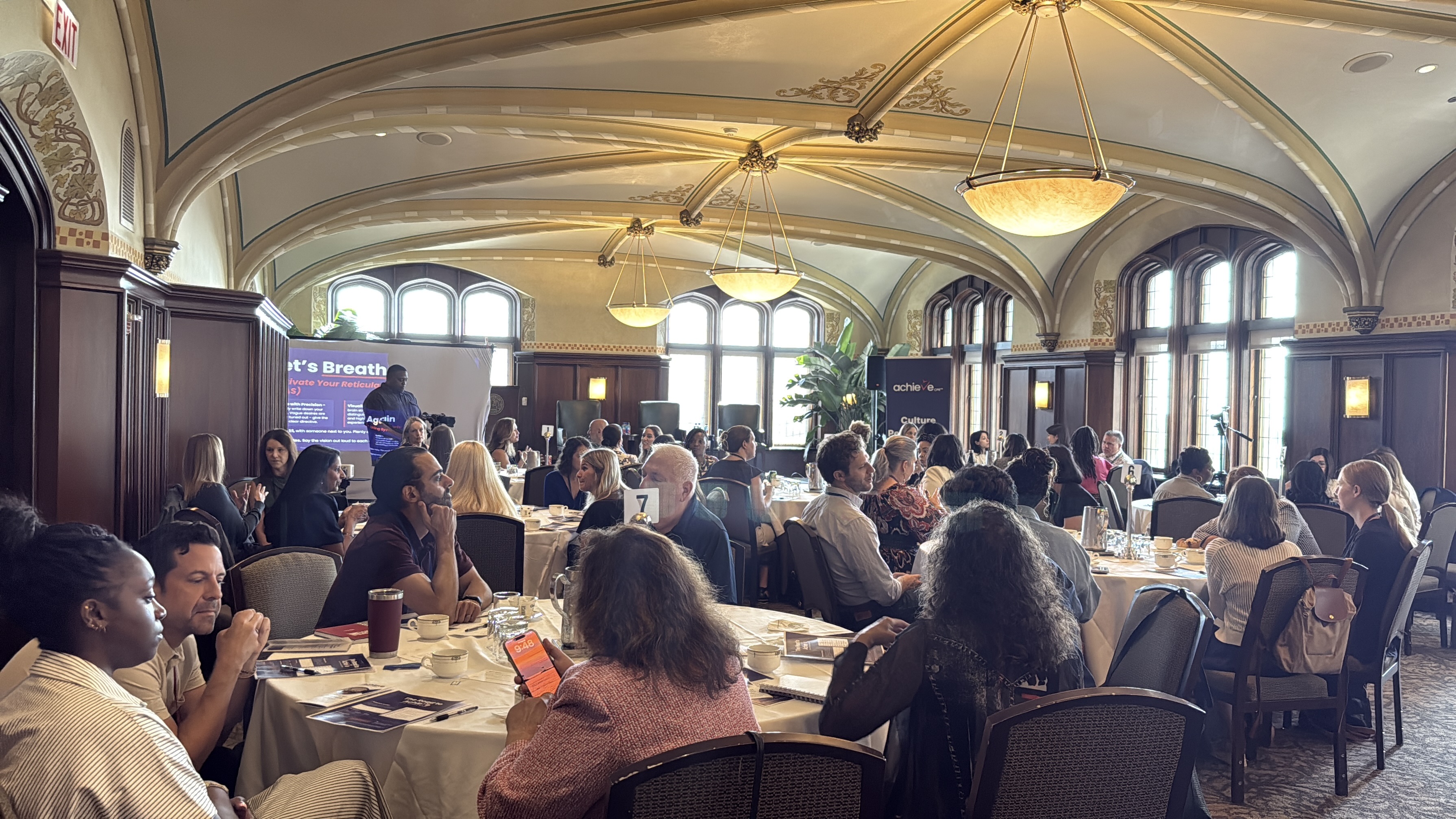
This panel opened achieveCPR™ LIVE in Chicago, a one-day, practitioner-led event built around the achieveCPR framework: Culture, Performance, and Retention. Host Zech Dahms guided Martire, Rosencrans, and Bauer through direct conversation before opening the floor to audience questions and structured peer discussion at each table. The morning was built around the three achieveCPR pillars in turn, with this culture panel setting the foundation for the performance and retention conversations that followed. The afternoon shifted into small-group, hands-on working sessions to help attendees turn the morning's frameworks into their own strategic playbooks.
What came through most clearly in the room wasn't a single formula. It was that three very different organizations, a private-equity-backed bakery scaling through acquisition, a global HR technology company managing ten entities, and a small Fortune 500 subsidiary split across two offices, arrived at strategic, measurable approaches to culture from very different starting points. The common thread was treating culture with the same discipline as any other business priority: named tactics, clear ownership, and a way to measure whether it's working.
Conversations like this one are exactly what the Achieve Leadership Network is built around: practitioner-led sessions where HR and people leaders share what is actually working in the field, not just what should work in theory. Members get access to the full recording of this panel, the peer playbook exercises from the afternoon session, and ongoing programming built around the achieveCPR framework throughout the year.
Learn more about joining the Achieve Leadership Network →
The Bottom Line
Global engagement is at a five-year low, manager engagement is eroding faster than any other workplace metric, and three out of four organizations say they're failing to build the high-performance culture their leadership wants. None of that is inevitable. The organizations bucking the trend share a pattern: they treat culture as a strategy with owners, cadence, and metrics, they invest specifically in manager engagement, and they close the loop on what they hear from employees instead of letting feedback sit. That is a harder, slower path than a values refresh or a new tagline. It is also, based on the data, the one that consistently works.