.png)
AI for HR Leaders: A 3-Level Framework That Works

AI for HR Leaders: Why Most Pilots Stall, and the Framework That Doesn't
Global employee engagement just fell to 20 percent, its lowest point since 2020, according to Gallup's State of the Global Workplace 2026 report. At the same time, a widely cited MIT study found that 95 percent of generative AI pilots inside companies never produce a measurable financial return. Put those two facts together and you get the moment HR leaders are living in right now: a workforce that is already stretched thin, and a technology rollout that mostly is not working.
That tension was the starting point for a recent session of Achieve's 2026 AI Innovation for HR Mastermind Series, where Desselen Wood, Global Chief People Officer at Syntax, walked a room of HR and people leaders through the enablement framework her organization built, broke, and rebuilt over several years. Her core argument: the gap between "everyone is using AI" and "AI is changing our results" is not a technology problem. It is an enablement problem, and it has a structure.
The Data Behind the Pressure HR Leaders Are Feeling
Three data points explain why AI enablement has become an urgent HR leadership skill rather than an IT side project.
First, adoption has outpaced strategy. Microsoft and LinkedIn's Work Trend Index found that 75 percent of knowledge workers now use AI at work, yet 60 percent of leaders privately worry their own organization lacks a clear plan and vision for implementing it (Microsoft Work Trend Index). Employees are not waiting for permission. Leadership is often not ready for what happens next.
Second, most pilots do not pay off. The MIT-affiliated NANDA initiative's "GenAI Divide" research, based on interviews with 150 leaders and an analysis of 300 enterprise AI deployments, found that only about 5 percent of AI pilots achieve rapid revenue acceleration. The rest stall, delivering little to no measurable impact on the P&L (Fortune). That failure rate is not a technology verdict. It is a signal that most organizations are rolling out tools without a plan for how work itself should change.
Third, the workforce absorbing all of this change is already fraying. Perceptyx's 2026 Employee Experience research warns that stable retention numbers can mask a workforce "too paralyzed by fear to pursue growth," meaning people are staying in their roles out of caution rather than commitment (Perceptyx). Layer a fast, forced AI rollout on top of that and the risk of quiet disengagement only grows. The chart below, shared during the session, lines up closely with this same set of findings.
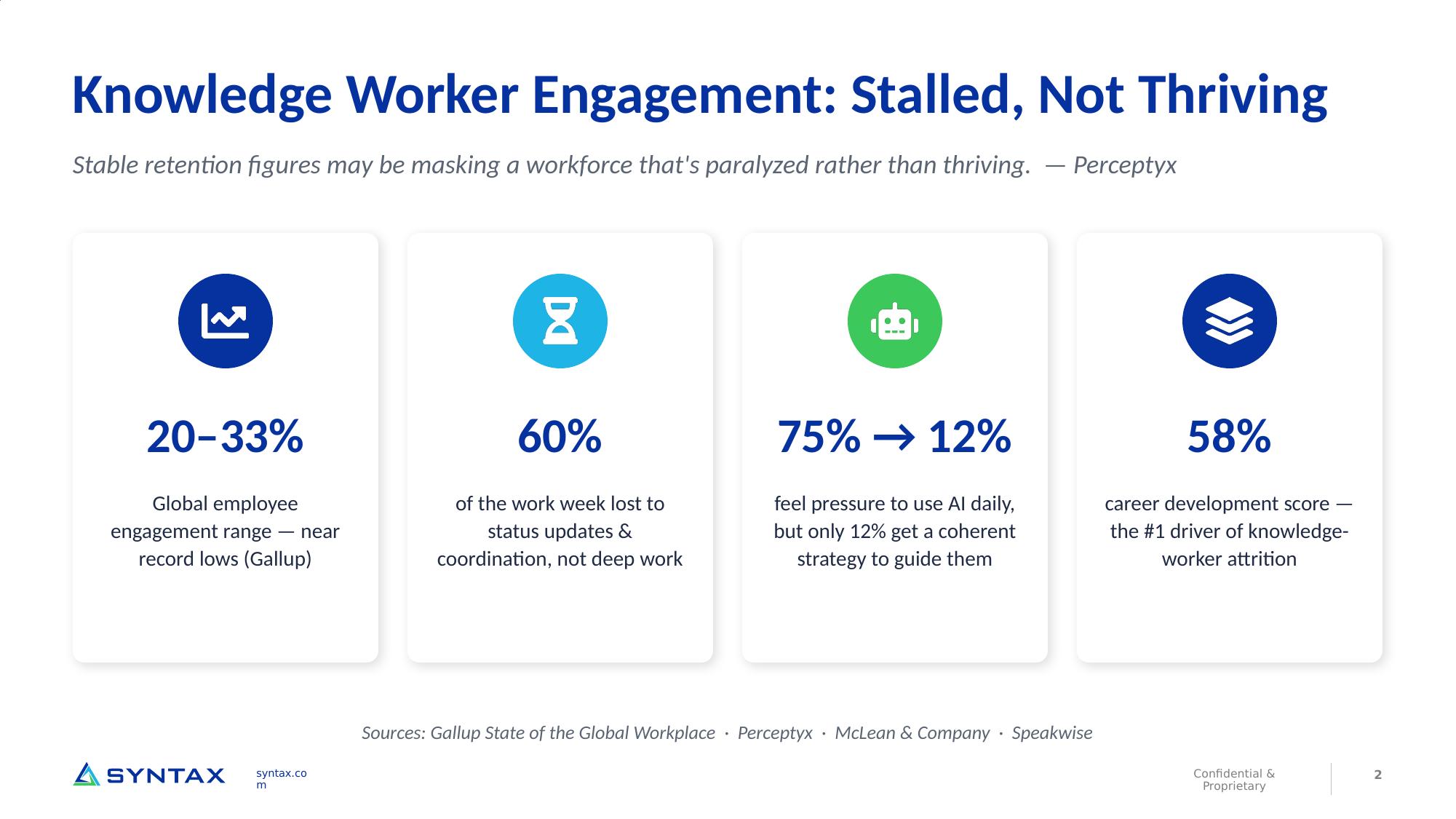
From the Achieve AI Innovation for HR Mastermind Series session, August 2026.
Why "Just Use It" Doesn't Work
Wood's starting observation matches a familiar workplace pattern: most people only ever learn the basic functions of a new tool. A minority becomes proficient, and a much smaller group masters it. She has watched this play out with Excel, Outlook, and Salesforce alike, and she built her AI enablement plan around that same distribution rather than fighting it.
This lines up with what the broader research on knowledge work already shows. Asana's Anatomy of Work Index found that the average knowledge worker spends about 60 percent of their time on coordination, chasing status updates, searching for information, and switching between tools, rather than on the skilled, strategic work they were actually hired to do (Asana). Handing that same worker a generic AI tool without a plan for which of their tasks to target does not fix the imbalance. It just adds one more tool to the pile.
A Three-Level Framework for AI Enablement
Rather than a single training event, Syntax built AI enablement in three tiers, each aimed at a different share of the workforce and a different kind of outcome.
Level one: productivity. Aimed at everyone (Wood estimates roughly 55 percent of a workforce lands here), this covers using AI as an assistant: drafting content, prepping for interviews, running better meetings. It is the non-negotiable floor, not the finish line.
Level two: role and process transformation. A bigger ask, aimed at identifying where AI should actually change a workflow. Syntax built a simple internal "AI roadmap agent" that asks employees a few discovery questions about their role and returns a view of what is most automatable and what success would look like.
Level three: building. Reserved for a smaller group of existing technology superusers (not simply AI enthusiasts) who go through a dedicated boot camp to build agents that a whole team, not just one person, can use.
Threaded through all three levels is a distinction Wood returned to repeatedly: the difference between elastic and inelastic roles. Payroll is inelastic. Processing it faster does not create more payroll to process, so time saved converts directly into headcount reduction. Recruiting and HR business partner work, by contrast, is elastic: freed-up admin time redirects into sourcing more candidates or coaching more leaders. Before assuming AI adoption should shrink a team, Wood's advice was to ask which kind of role you are actually looking at.
Why Most Organizations Stall at Stage Two
Wood also shared the four-stage AI maturity curve she uses internally at Syntax: tooling and training completion, organic agent building and adoption, measurable P&L impact, and a fully reimagined operating model. Her honest assessment, echoed by most attendees in the room, is that the majority of organizations get stuck at stage two. Training gets completed, agents get built, and usage numbers look healthy, but none of that activity has yet been tied to a measurable business outcome. Moving to stage three is less about better AI and more about building the measurement layer, an AI usage ledger, a defined goal, a named owner, that turns activity into evidence.
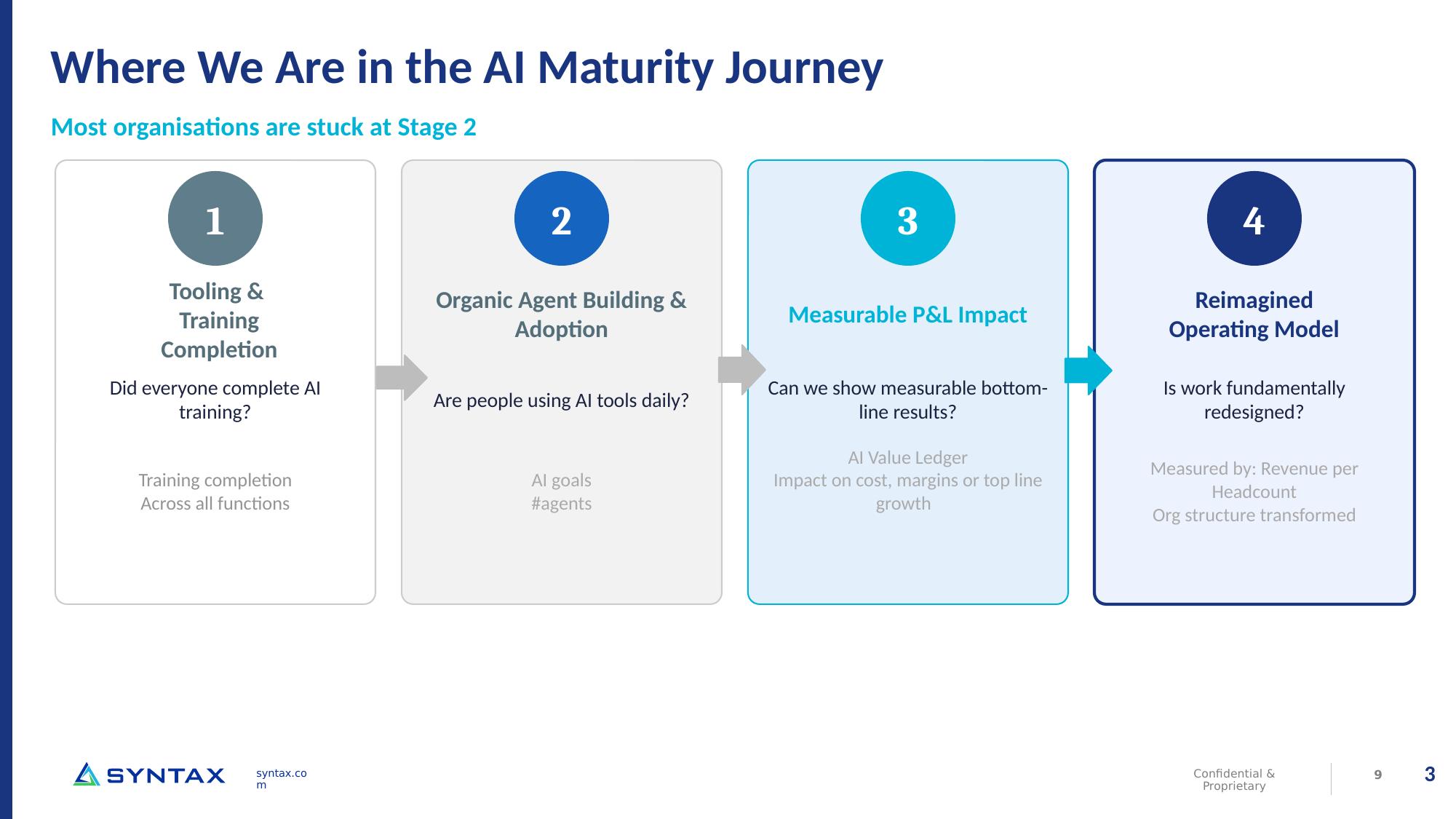
Most organizations, Syntax included for a period, get stuck at Stage 2: measuring activity instead of outcomes.
Turning Enablement Into a Business Case
The clearest proof point from the session came from talent acquisition. A designated "AI Champion," paired with the department's VP, launched a set of live agents covering resume formatting, job description translation, skills extraction, and sourcing. Across the recruiting team, those agents saved dozens of hours per recruiter per month. Because recruiting is an elastic function, that time converted into covering more open roles and absorbing higher hiring volume without adding headcount, including covering a maternity leave without a backfill.
The mechanism that made this measurable, rather than anecdotal, was an AI usage ledger: a simple tracking system that estimates time saved, corrected by the employees who actually built and use the agents, then tied back to leaders as a real business case. This is the piece most organizations skip, and it is exactly the stage-two-to-stage-three gap described above.
What This Looked Like in the Room
The Mastermind format meant the session was as much a peer exchange as a presentation. One HR leader from healthcare described her organization as being at the very start of the journey because of HIPAA-related caution, with her team currently limited to a single sanctioned tool. Another, whose company had recently been acquired, shared that her organization's enterprise AI license is limited to a 35-person leadership team for now, with broader access waiting on training people through what information is and is not appropriate to share with these tools.
Several participants compared notes on whether AI use has become part of formal performance reviews yet. The answers ranged from "not yet, since it was not set as a goal at the start of the year" to "yes and no, not at a deeper level," suggesting most organizations represented in the room are still earlier in this process than Syntax, which folded AI-related goals into every employee's performance objectives this year.
Wood was candid that even her own organization does not have every answer. Asked about return on AI investment, she pointed to functions like software development, where AI-driven productivity gains are large mostly because developers were the earliest and heaviest users, not necessarily because coding is the role best suited for automation. She was equally direct that she does not yet have a clear answer for customer service roles, since current chatbots handle only a limited range of interactions well. That mix of a working framework and open questions is, in itself, useful modeling: enablement does not require having every answer before you start.
What This Means for HR Leaders Building Their Own Roadmap
Three implications stand out for people leaders building an AI strategy of their own.
First, career development is quietly one of the highest-stakes places to get AI enablement right. McLean & Company's Employee Engagement Trends Report 2026 found that career advancement and development sits at just 58 percent favorability and remains the number one reason employees leave organizations (McLean & Company). Framed well, as Syntax did by putting AI proficiency levels directly into job postings and performance goals, AI enablement becomes a career development lever rather than a threat. Framed poorly, as a forced adoption mandate with no path forward, it becomes one more reason to disengage.
Second, sentiment work is not optional. After training and goal setting rolled out, Syntax's own AI sentiment survey found strong majorities of employees felt informed about AI progress and prepared to use it, alongside real concerns about forced adoption, tool reliability, and the time available to build proficiency. Listening after the rollout, not just before it, is what let Wood calibrate the next phase instead of guessing.
Third, the elastic-versus-inelastic distinction deserves a place in every HR leader's AI vocabulary. It reframes the conversation with finance and operations away from "how many people can this replace" and toward "what does this free our people to do instead," which is a fundamentally different, and often more accurate, way to talk about AI's impact on headcount.
Build Your Own AI Enablement Roadmap
Sessions like this one are the reason the Achieve Leadership Network exists: a space where HR and people leaders bring real frameworks, real numbers, and real unanswered questions into the same room, rather than trading AI hype in isolation. If you are building your own AI enablement plan and want to work through it alongside other Chief People Officers and HR leaders facing the same pressure, this Mastermind Series continues through the end of the year.
Learn more about joining the Achieve Leadership Network and get access to the full AI Innovation for HR Mastermind Series, plus the broader library of masterclasses, playbooks, and peer conversations built for people leaders navigating exactly this moment.




.jpg)