.png)
AI for HR Leaders: The Amplifier Paradox Explained
AI for HR Leaders: The Amplifier Paradox and the Cost of Getting Faster
Endoscopists who grew used to an AI assist during colonoscopies saw their own, unaided ability to spot precancerous growths drop six points, from 28.4 percent to 22.4 percent, within months of the tool's introduction, according to a study in The Lancet Gastroenterology & Hepatology. The tool worked exactly as intended. The skill underneath it did not survive contact with convenience.
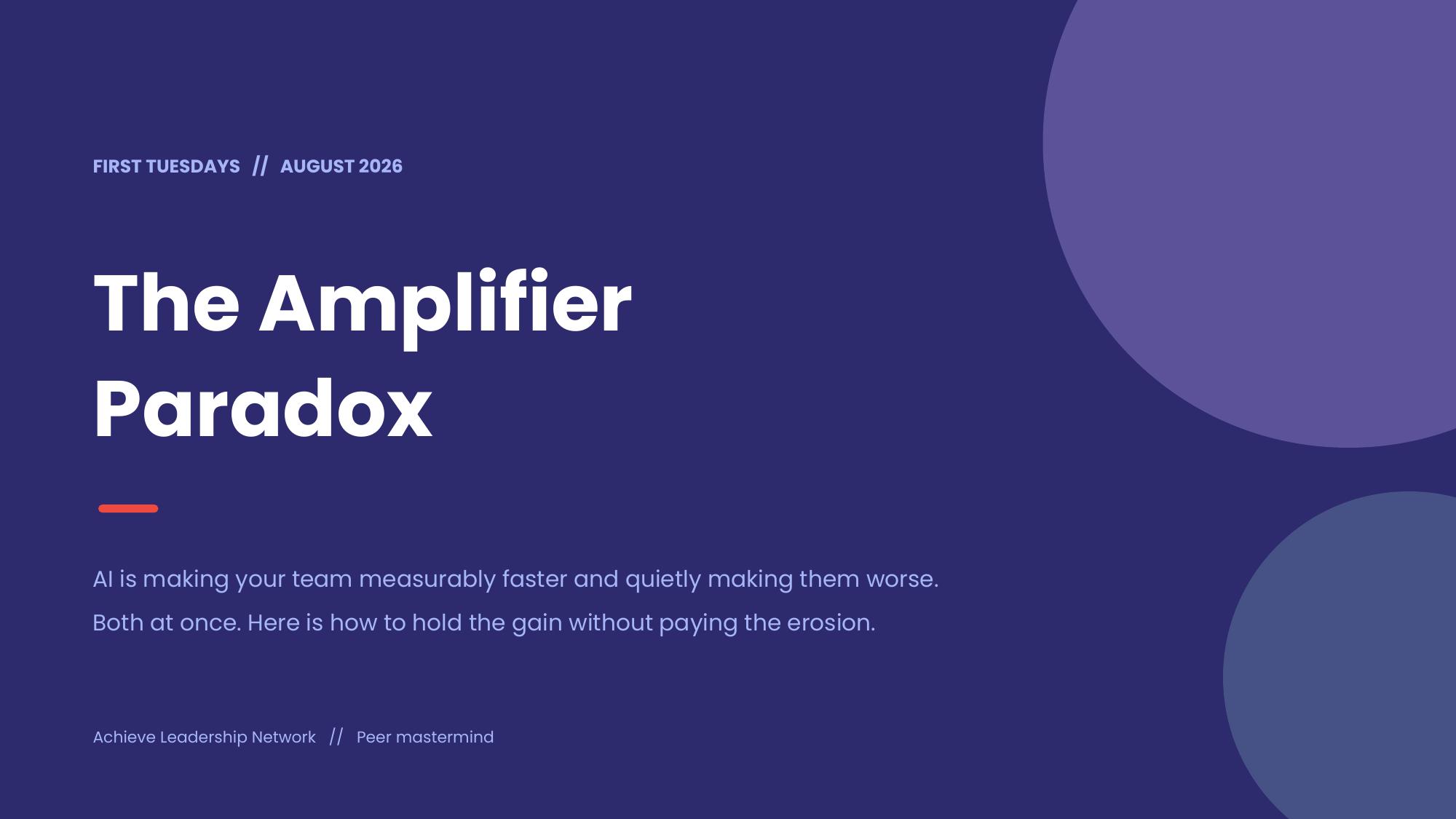
That is the pattern AI for HR leaders now have to reckon with, and it does not stay inside hospitals. Across industries, researchers keep finding the same shape: AI makes people faster and their underlying judgment thinner, at the same time, for the same reason. A year-long study presented at the 2026 CHI Conference on Human Factors in Computing Systems gave this pattern a name, the AI as Amplifier Paradox, and gave the hidden half of it a name too: intuition rust. For anyone leading people through this shift, the real question is not whether AI helps. It clearly does. The question is what else it is quietly doing, and whether a performance and talent function that only measures the first half of that story would ever catch the second.
The Amplifier Paradox: When Faster and Worse Happen at Once
The term comes from a year-long study of AI use inside a high-stakes workplace: radiation oncology specialists using an AI planning tool over twelve months. Researchers described AI's dual role and called it the amplifier paradox, its ability to strengthen performance while eroding the underlying expertise that performance depends on (CHI 2026). By month nine, several specialists could describe what was happening to them. One told researchers what it felt like:
"It's like I've unlearned some optimizations I used to know by heart."
(study participant, month nine)
Researchers named that gradual dulling of judgment intuition rust. They also borrowed a second term from medicine to explain why it is so easy to miss: asymptomatic. An asymptomatic effect is a behavioral shift that escapes standard performance metrics because it produces no visible symptom, no dip in output, no flag on a dashboard. That is precisely what makes this hard for AI for HR leaders to manage well. The metrics that show output is up are working exactly as designed. Almost no performance system currently has a metric that would show judgment quietly going down.
The Evidence Is Not Limited to One Study
The colonoscopy finding is not an outlier. It is one of at least four independent lines of research, across different professions and different methods, pointing the same direction.
At an accounting firm studied by researchers at Aalto University, reliance on automated tools bred a specific kind of complacency: staff lost not just the habit of doing the work by hand, but the ability to assess whether an automated output was even right. Separately, Microsoft Research and Carnegie Mellon University surveyed 319 knowledge workers about nearly 1,000 real AI-assisted tasks and found a clear inverse relationship: the more a worker trusted the AI, the less critical thinking they applied to its output, and the more they trusted their own judgment, the more critical thinking they did. At the broadest level, the 2026 International AI Safety Report, backed by more than 30 countries and authored by over 100 AI experts, flagged emerging evidence that routine cognitive delegation, offloading small decisions to AI again and again, may be affecting critical thinking and memory more broadly.
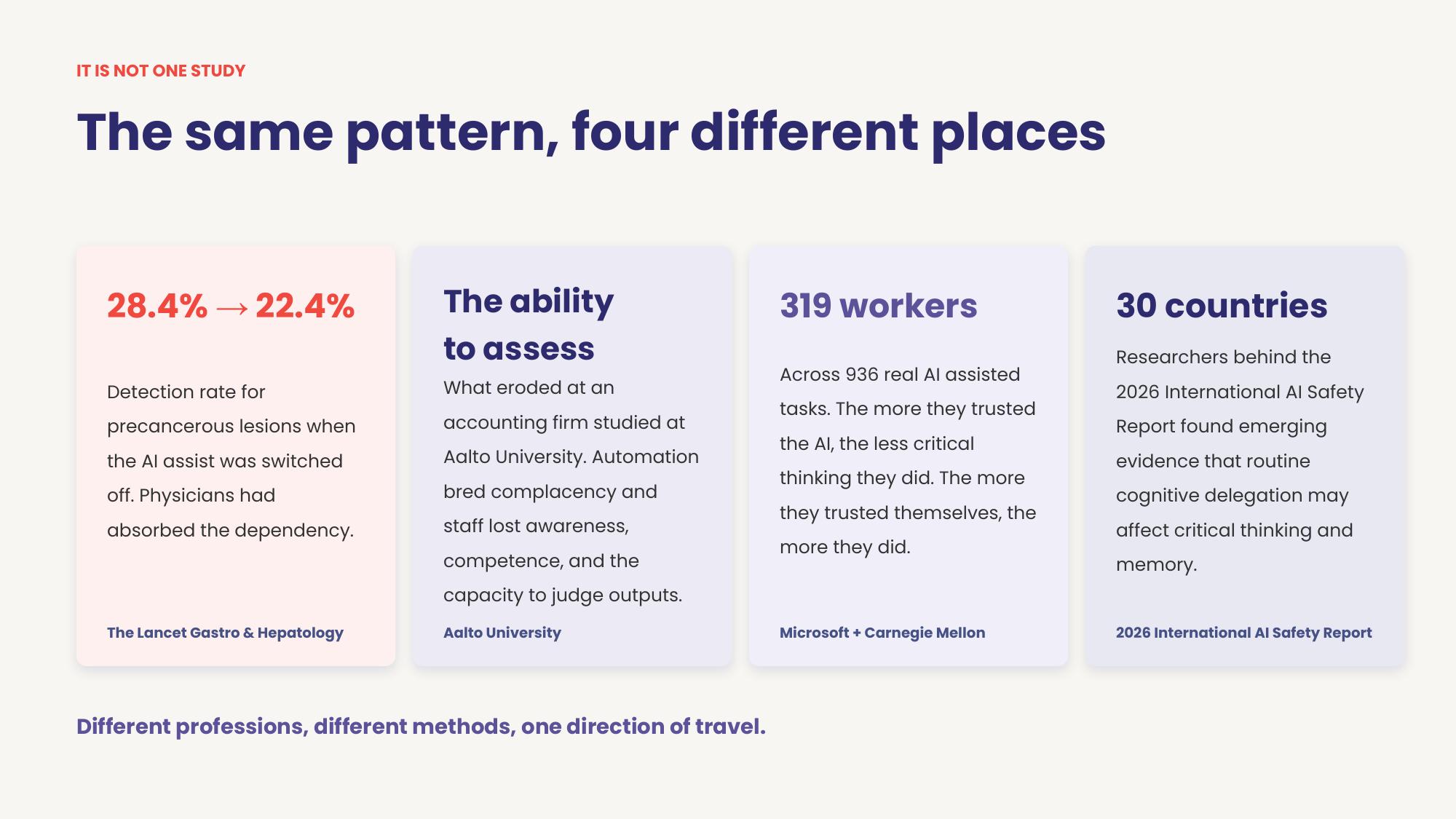
None of these researchers set out to study each other's industries. A hospital study, an accounting firm case study, a cross-industry worker survey, and a global policy report all landed on the same shape: real, measurable productivity gains sitting on top of a skill base that is quietly thinning. For HR and people leadership teams, that convergence matters more than any single number. This is not a hospital problem or a knowledge-work problem. It is a judgment problem, and AI in HR conversations will need to reckon with it in every function that has adopted these tools in the past two years.
The Shadow Rating System: How This Already Shapes Trust and Promotions
While researchers were measuring skill erosion, a second, faster-moving effect was showing up in how colleagues actually treat each other's work. BetterUp Labs and Stanford's Social Media Lab surveyed 1,150 full-time US workers and found that 41 percent had received AI-generated content in the past month that looked finished but did not actually move the work forward, a pattern they named workslop. Each incident cost the recipient close to two hours of rework. More strikingly, roughly half of the people who received workslop rated the sender as less creative, less capable, and less reliable afterward, 42 percent said they trusted that colleague less, and about a third said they wanted to work with that person less going forward. This shapes employee experience as much as it shapes any performance rating.
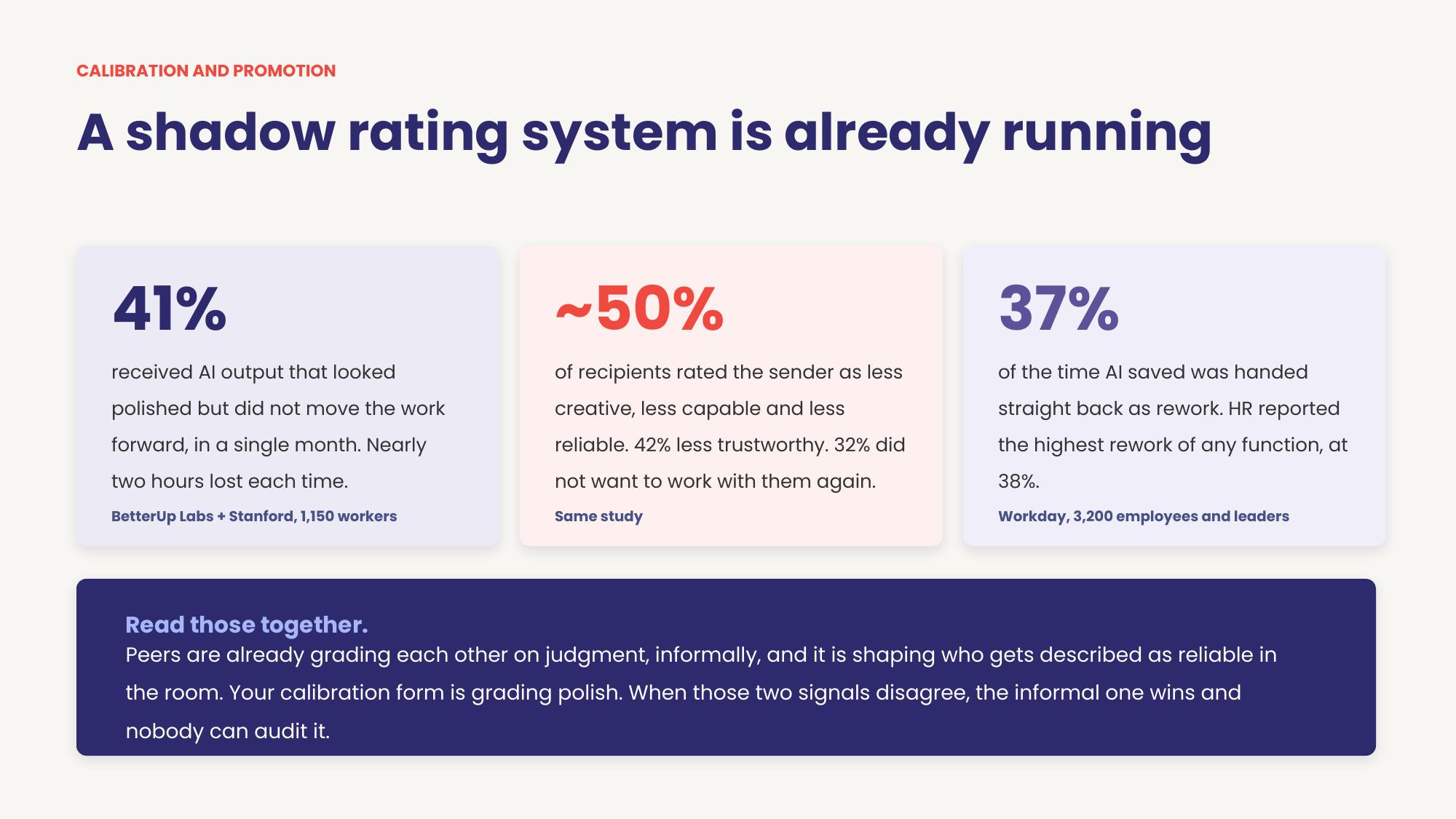
Workday's global study of 3,200 employees and leaders found a related pattern from the productivity side: 37 percent of the time AI saves gets handed straight back as rework, and HR professionals reported the highest rework burden of any function surveyed, at 38 percent. Together, these findings describe what amounts to a shadow rating system: an informal, undocumented way peers already grade each other's judgment, running in parallel with, and sometimes ahead of, whatever a formal performance review captures. For a Chief People Officer, that is the number worth sitting with. One more data point adds context: Betterworks' 2026 research found that only 8 percent of employees say their company has communicated a clear AI vision. Scrutiny without context tends to produce concealment, not better judgment, which is exactly the gap most organizations are standing in right now.
A Framework AI for HR Leaders Can Actually Use
None of this is an argument against AI. It is an argument for measuring the whole picture, not just the half that shows up automatically. One practical model, sometimes called the expertise loop, breaks into four practices for protecting judgment while still capturing AI's speed.
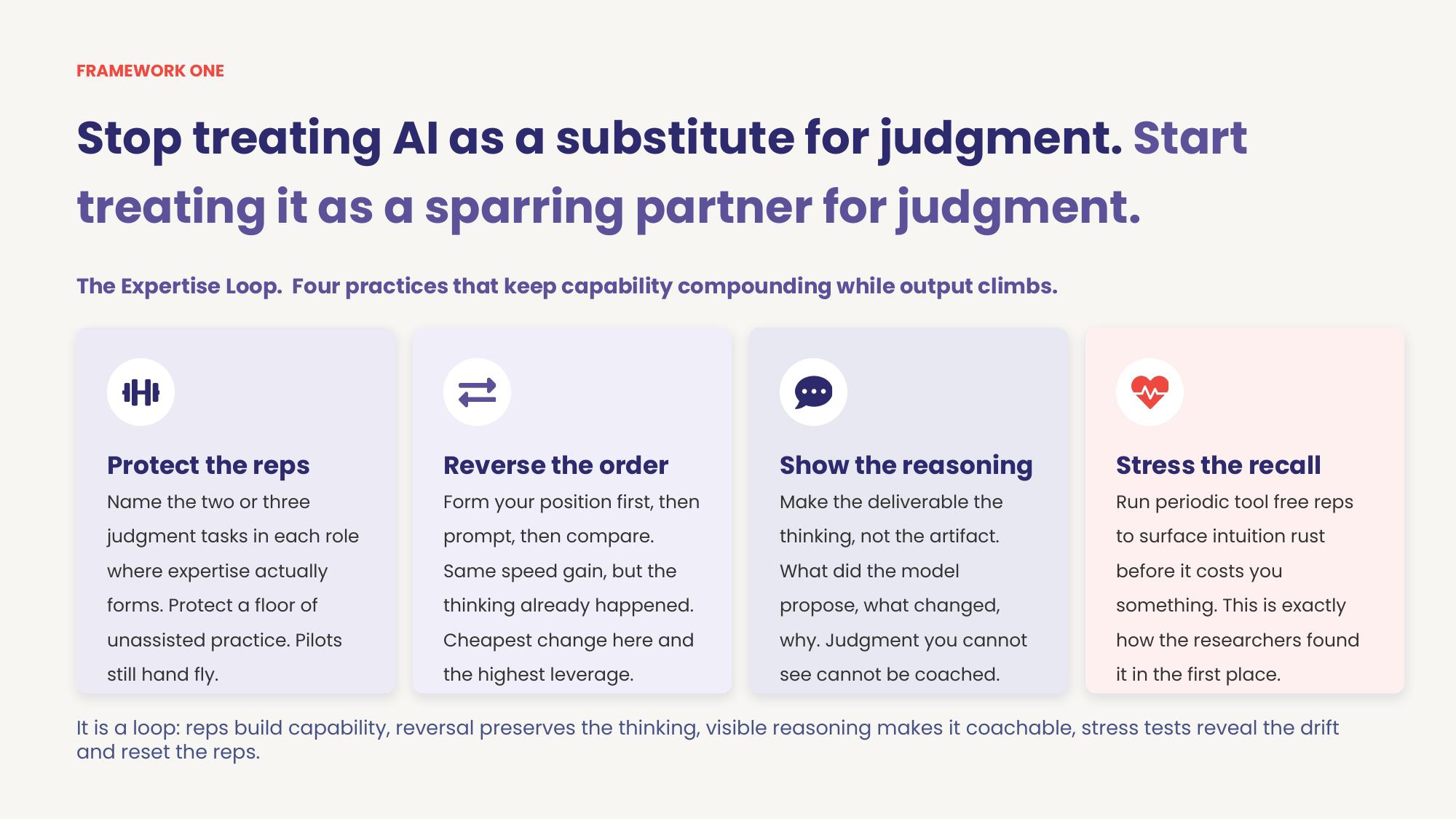
Protect the reps, by naming the two or three judgment tasks in a role where real expertise forms and keeping a floor of unassisted practice around them, the way airline pilots still hand-fly on a regular basis so a skill they rarely need in an emergency never lapses. Reverse the order, forming a position before prompting, then comparing it against what the AI produces, which preserves the thinking a prompt-first habit skips over. Show the reasoning, treating the deliverable as the thinking behind a decision and not just the polished artifact, since judgment that never becomes visible can never be coached. And stress the recall, running periodic, tool-free repetitions to surface intuition rust before it costs the organization something real.
The same logic extends into performance management. Splitting the scorecard, recording what a tool amplified (volume, speed, polish) separately from what stayed attributable to the person (how they framed the problem, what they rejected and why, the calls they made under real ambiguity), and rating and promoting only on the second column, gives HR leadership skills and manager effectiveness a concrete, gradeable definition again instead of a vibe.
What This Looked Like in the Room
This was the core of the conversation at the Achieve Leadership Network's August mastermind, part of First Tuesdays, the peer-powered HR community that opens every month with a facilitator-led framework and small-group problem solving. Host Zech Dahms walked the group through the amplifier paradox research and the frameworks above, and the room, HR and people leaders across healthcare, professional services, and other industries, pushed back, added their own examples, and stress-tested the ideas in real time.
One member described a healthcare policy that keeps AI out of anything touching a patient chart while allowing it for non-clinical work, and pointed to airline pilots as a model worth borrowing. Another offered a sharper reframe: most of what looks like an AI problem is actually a habits problem, treating AI as an answer machine instead of a thought partner. A third shared a real hiring round where a wave of AI-flattened interview answers got caught, and simply, not advanced. That is the value of a room like this: the framework holds up a lot better once it has been argued with by people living inside it every day.
Bring This Conversation to Your Team
The amplifier paradox is not a reason to slow down on AI. It is a reason to measure more than output, and to build the muscle for catching judgment loss before it becomes a promotion decision, a hiring mistake, or worse. If this is the kind of conversation your organization needs more of, Achieve Leadership Network is an HR professional membership built around exactly this: small peer groups of HR and people leaders working through problems like this one together, every first Tuesday.
Learn more about First Tuesdays and the Achieve Leadership Network to see what's covered in the next session.